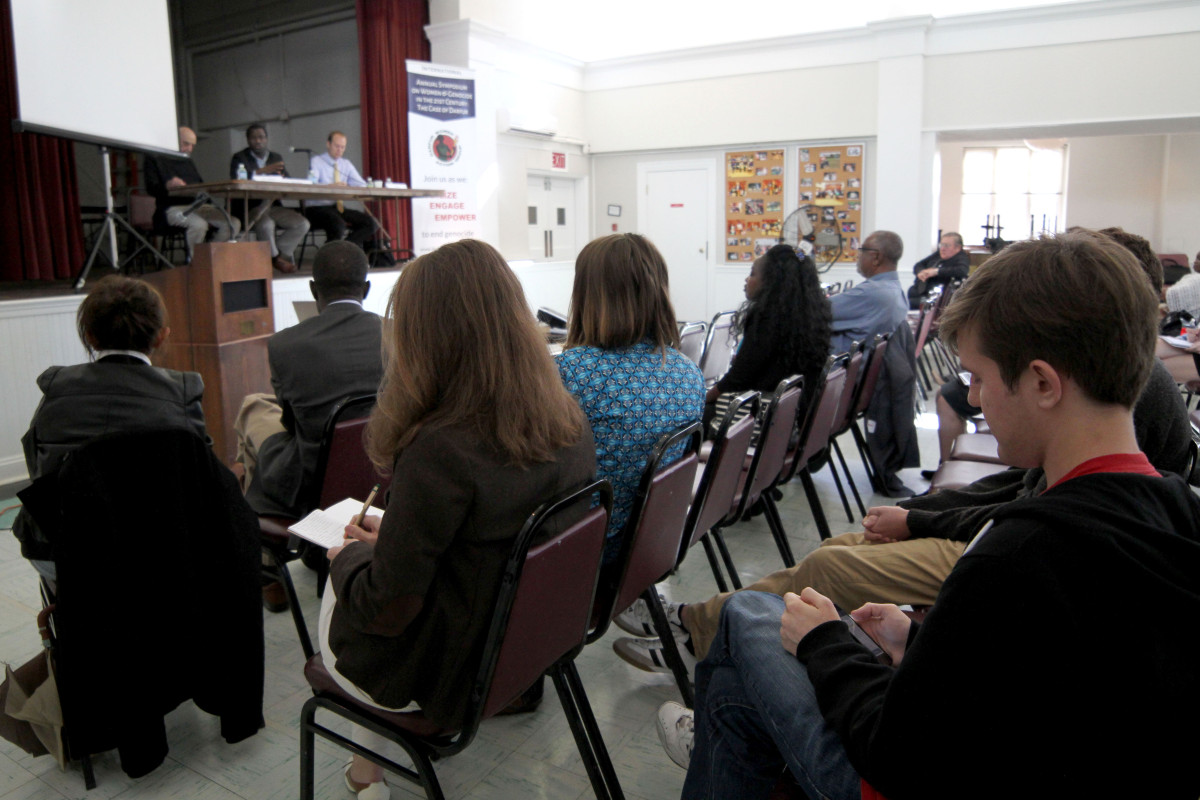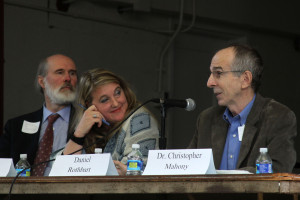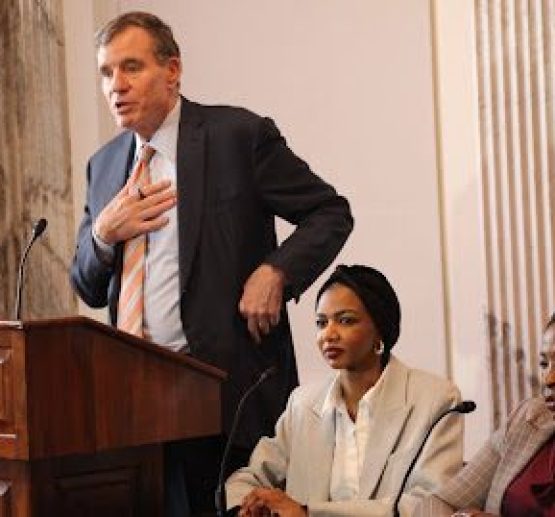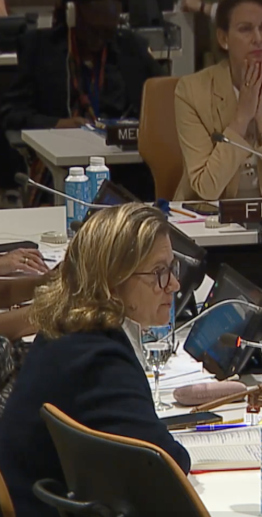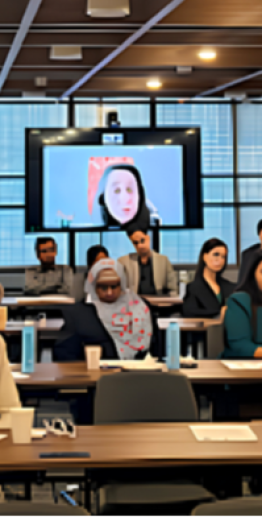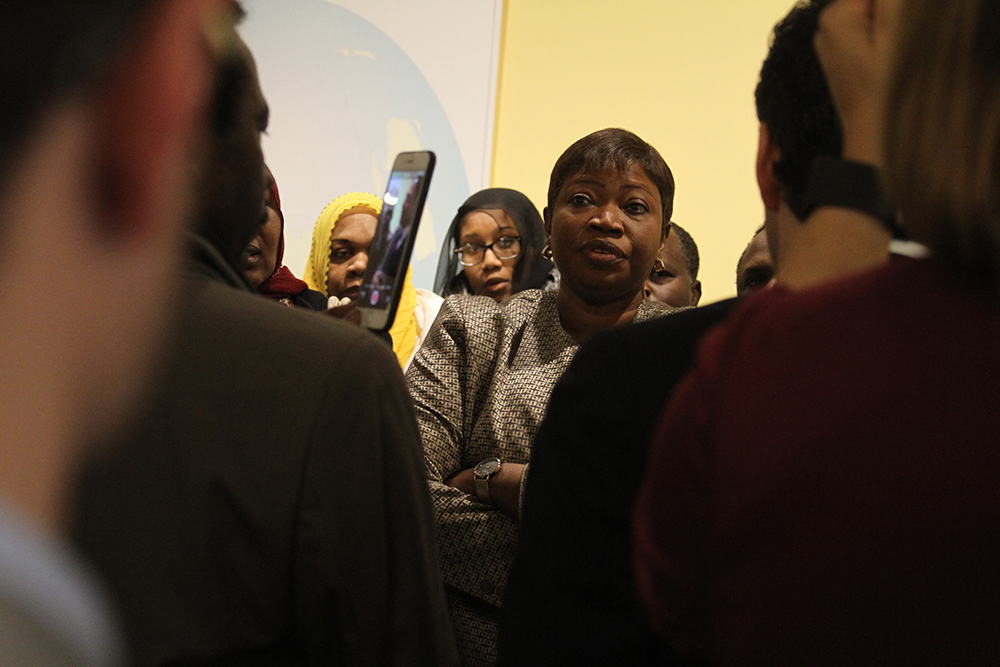
DWAG President Niemat Ahmadi and team members attended the ICC prosecutor’s 24th report on the Darfur case to the United Nations Security Council. During the briefing, ICC reinforced its commitment to arrest President al-Bashir for war crimes and genocide.
Carla Ruas
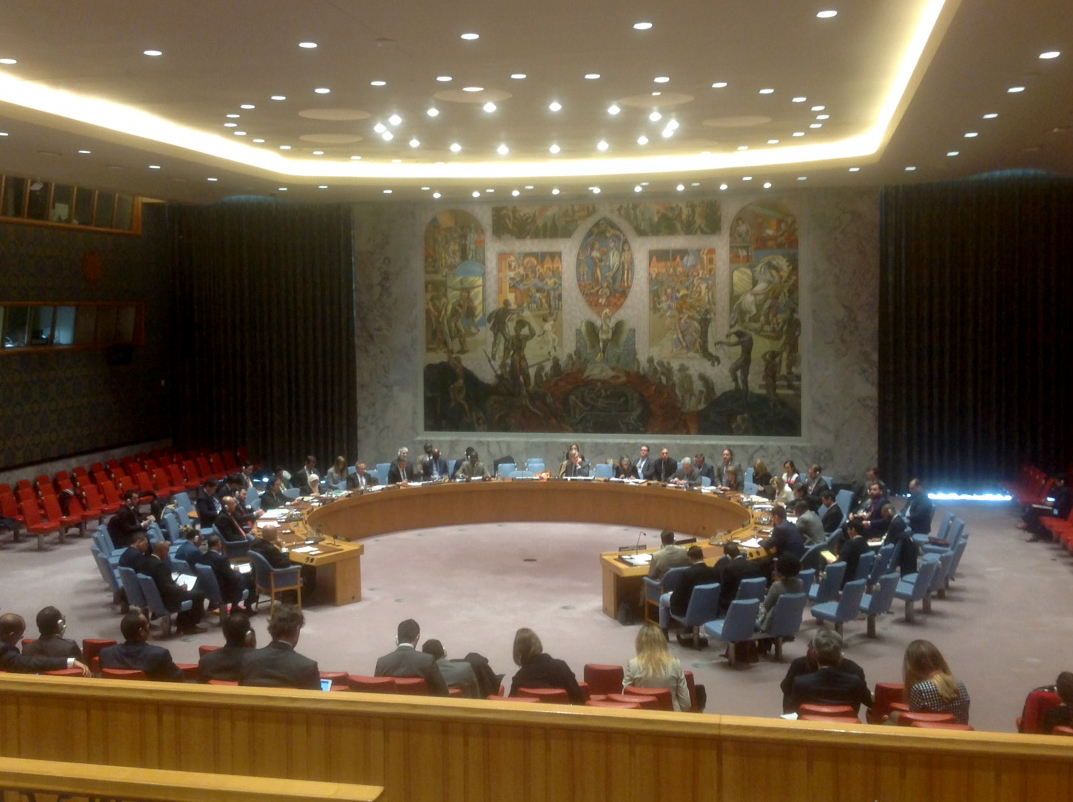
“What are we to say to victims who continue to suffer in Darfur?” Gambian lawyer Fatou Bensouda, a prosecutor with the International Criminal Court (ICC), asked the United Nations Security Council (UNSC) last Tuesday, December 13. Ms. Bensouda was briefing the council for the 24th time about the the ICC’s ongoing investigation into the genocide in Darfur. And in the process, she wanted to know why they had not done more to help her office seek accountability. “Victims, including some that I have met personally, are puzzled and dismayed by the council’s lack of action,” she stated.
Ms. Bensouda’s impatience is justified. The Darfuri genocide has been ongoing for 13 years and civilians have had little relief from the dire situation inflicted by the Sudanese government. Women and girls continue to suffer rape and sexual assaults. Civilians remain in Internally Displaced People (IDP) camps far away from their homes. And men who oppose the government are summarily tortured and executed on a daily basis. “Time may lapse, but time does not erase the fact that serious crimes have been committed in Darfur,” the prosecutor stated, as members of the council and Sudanese activists in the audience listened attentively.
Since April 2016, according to Ms. Bensouda’s investigation, the situation has actually worsened in parts of Darfur. In the mountainous area Jebel Marra, hundreds of civilians have been victimized by government aerial bombardments. Also, a recent report by Amnesty International has indicated that the government may have deployed chemical weapons in the region earlier this year. At least 250 people, including children, have died due to the exposure to such chemicals. (Ms. Bensouda reassured the council that her office is investigating the allegations and working to prove the attacks, in spite of the Sudanese government’s efforts to isolate the region.)
As the situation worsens, so does the impunity for those responsible for the genocide. The ICC has issued five arrest warrants against Sudanese government officials accused of committing crimes against humanity, war crimes and genocide in Darfur. According to Ms. Bensouda, all five suspects are still at large, and three of these men continue to have a prominent position in the Sudanese government. One of them, of course, is President al-Bashir, whose arrest warrant was issued a staggering eight years ago.
The prosecutor was not afraid to criticize the ICC member states and UNSC member states for not making an effort to arrest al-Bashir as he crosses international borders unimpeded. Since March 2009, the president has traveled on 131 occasions to attend events ranging from presidential inaugurations to international sporting events. On 14 of those occasions, al-Bashir traveled to ICC member states, and in 117 to non-member states. “His movements are traceable. The world knows where he is and where he travels to, often in advance, from the media. There is ample opportunity for Mr. al-Bashir to be apprehended if the political will exists among states and this council,” she pleaded.
Ms. Bensouda reminded those present that the ICC is only a judicial pillar; therefore, it has no police power. According to the United Nation’s Rome Statute, the states must reinforce the court’s decisions. And such reinforcement is not optional. South Africa, for instance, has recently been called to explain its refusal to arrest Mr. al-Bashir during his visit to the country in June 2015. However, let us not forget that the UNSC has its own share of responsibility in this case. Lack of action from the council has no doubt encouraged many states to host President al-Bashir without fear.
After the presentation, council members were asked to give their opinions about the report.
The overwhelming majority of members (including five permanent
members China, France, Russia, the United Kingdom, and the United States) expressed an unwavering support for the court and raised extreme concern about the escalation of violence in Darfur. Some states reinforced the urgency to act by referencing the ongoing sexual violence against women and girls in Darfur, where rape is often used as a weapon of war: “Attacks on civilians and sexual violence continue and must be brought to an end. We urge parties to resort to dialogue to achieve a lasting political settlement,” said the representative from Malaysia. Others expressed concern about the use of chemical weapons by the Sudanese government. “The use of chemical weapons should push this council to act even more,” said the representative from France.
Egypt, Angola, and China’s members sided with the Sudanese government, which was no surprise for the council, the prosecutor and us.
Lastly, the government of Sudan issued their own statement on the matter, shamelessly describing the prosecutor’s report as “pointless monologue and blatant lies.” The Sudanese representative claimed that there is peace in Darfur since September 2016, when in reality, Sudan continues to attack the Nuba Mountain and Blue Nile regions, violating the referenced peace agreement. Overall, Sudan’s representative used unprofessional language and made baseless accusations to the court. The statement was undiplomatic in its tune, which shows that the Sudanese government is desperate and lack confidence.
Following the briefing, Ms. Bensouda met with the Darfuri diaspora and NGO representatives who were watching from the gallery. Everyone was very eager to speak to her and show their support. In a passionate conversation, the prosecutor assured the crowd that “in spite of the challenges, my office is committed to continuing investigating and doing whatever is possible to deliver justice to the victims.” On their end, activists (some who came from NY, Philadelphia, and Washington D.C., including our team) assured the prosecutor that they will do whatever it takes to help her office seek justice for victims.
At the end of the day, the briefing renewed the energy of council member to support the people of Darfur and the ICC. Our hope is that the council will go beyond words and actually take action to improve the situation in Darfur. On our part, as citizens, we must continue to speak up and make it clear to our leaders that justice is the only way to end the longstanding crises in Sudan. We must remind our representatives that it is their legal and moral obligation to step up. They must make it clear to al-Bashir that impunity for such heinous crimes is not an option.
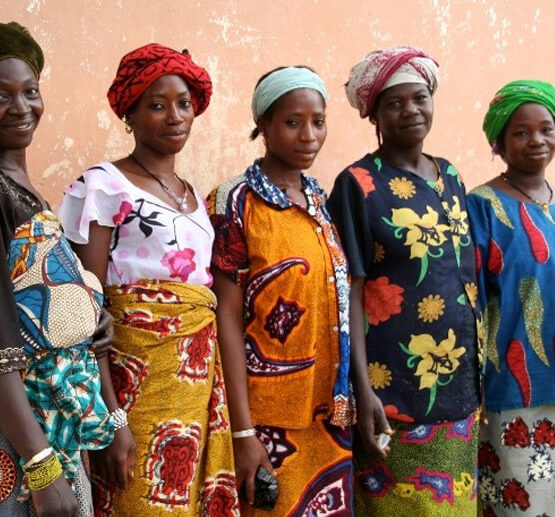
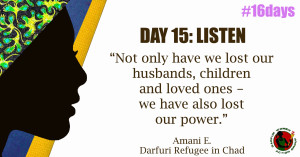 Our new home was a dry desert with very few trees. It was windy and dusty. Many people felt sick and there was no medicine. We had to improvise in order to survive. We walked took daily walks to a nearby forest, where we gathered wood to make food and straws to use as clothes and sheets. It was much later when the humanitarian organization International Rescue Committee came to us offering basic aid such as food and health assistance. Even then we felt lost and helpless. We had lost everything.
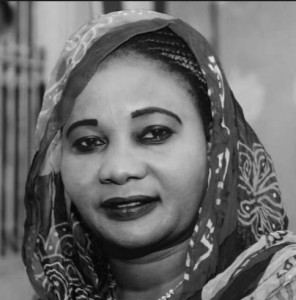 “I was born in Kurdufan, an area in Western Sudan. My family is from Darfur and still live there, so I consider myself to be a Darfuri as well. As a child, I used to enjoy watching movies on television, particularly the ones that had female characters that were journalists. They seemed so empowered and independent – everything that I wanted to become someday. As a teenager, I began imitating those characters by writing for school magazines and newspapers. I eventually went to college to study journalism. In 2001, I graduated and started working for a local newspaper in the capital of Sudan.
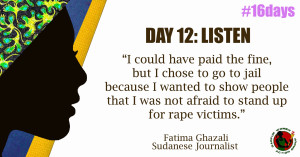 also took me to court and unjustly charged me with the crime of “publishing false news”. A Sudanese court tried my case and ruled that I was guilty. A judge sentenced me to one month in jail, unless I paid a fine of 2,000 Sudanese pounds (US$ 300). Five other journalists were accused of the same crime at the time, but were released. Another female journalist was sentenced along with me, but she filed an appeal and was also released. I believe that I was particularly targeted because I have roots in Darfur – and the government does not look kindly on Darfuris.
 We kept running for most of the night. A few hours before dawn, someone in our group said that we should stop, find a place away from the road and get some sleep. I was very thirsty, but luckily a woman who looked just like my mother had a gallon of water that she had been carrying on her back. She gave each one of us a sip of water – but just a little, because there was a long road ahead of us and the water had to last. People started counting their family members, and I found that my youngest sister and brother were missing. I cried, and decided that I could not go ahead without them. I wanted to go back to the village to find them. But others in the group convinced me that there was no one left in the village, and that when we reached the city I would be reunited with my family.
 #GivingTuesday is a global day of giving that brings diverse organizations and communities around the world together to give back. Our team is pleased to invite you to take this opportunity to engage in something meaningful for you and others.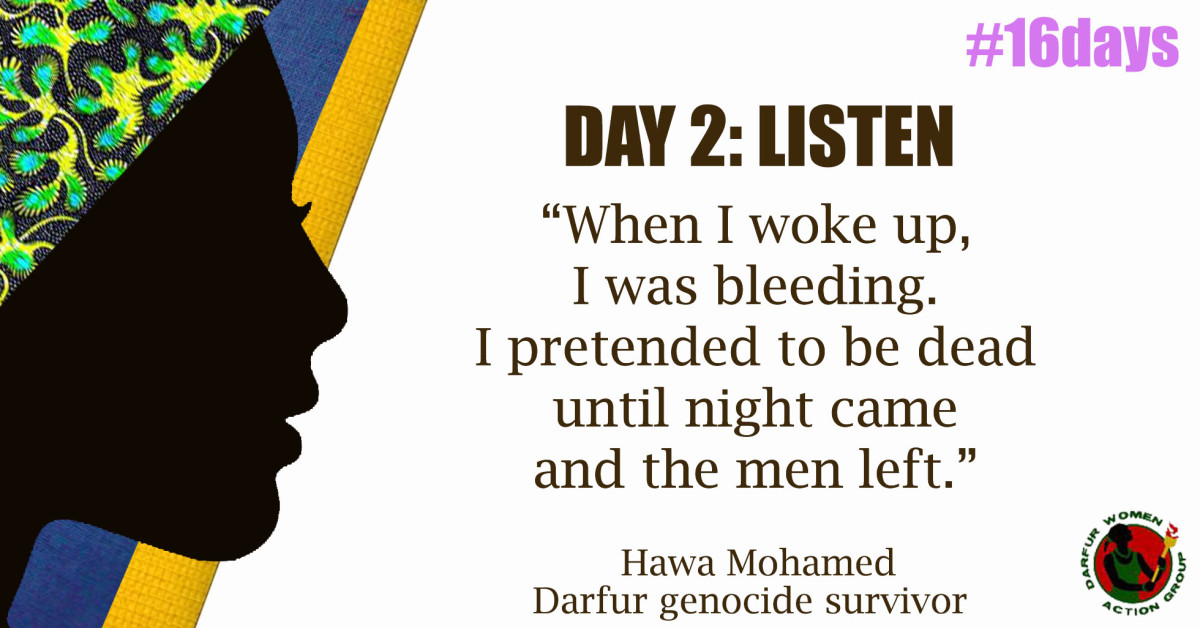
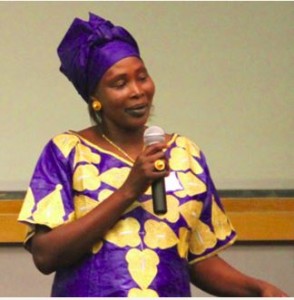 “I lived in a beautiful village in Darfur surrounded by tall acacia trees. Towards the west there was a green valley named Azum that provided us with mango, guavas, oranges, and beautiful gardens for six months during the rainy season. Toward the east there were sugarcane farms. I considered everyone in my village to be rich. Through hard work they cultivated all types of grains, vegetables and fruits. They also raised goats, sheep and cows. Most people had what they needed to survive and only went to the market to buy clothes, soap and sugar. Everyone was very friendly and supportive. If you needed help building a house, the community would come together and finish the house in one day. Life was beautiful and I was very happy.
 . And after six months, I was finally reunited with my husband. Since the attack to our village, he had been missing. I learned that he had been seriously wounded and was in a remote village in Darfur. I notified the International Rescue Committee and, thankfully, they found him and brought him to Chad. When he arrived, I could barely recognize him. Due to his injuries, he became permanently physically disabled.
 THIS IS IMPORTANT.