
At DWAG, we believe ending and commemorating genocide can’t be limited to commemoration. It needs serious action on protection, prevention, and accountability.
24 April 2026
Darfur Women Action Group (DWAG) hosted an event on Sudan on April 24, 2026, in Washington DC to mark Genocide Awareness and Prevention Month. It co-hosted the event with No Business with Genocide, Genocide Watch, Alliance Against Genocide, and United Nations Association – National Capital Area. Titled “A World Without Genocide: The Case of Sudan”, the event brought together survivors, experts, policymakers, and advocates to address the urgent failures that allow genocide to persist.
Opening Reflection
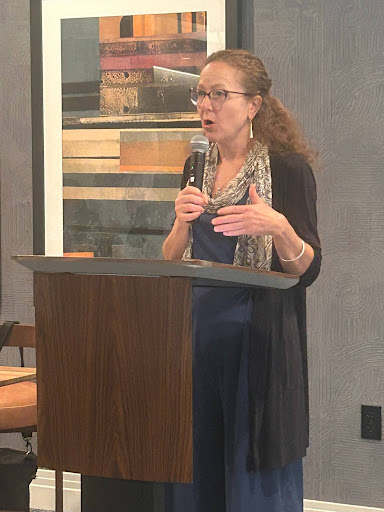
The event opened with remarks from Bridget Moix, General Secretary of the Friends Committee on National Legislation (FCNL) and DWAG board member, who reflected on her years of advocacy during the Darfur genocide. She noted that many advocates have spent decades working to push governments and institutions to respond more meaningfully to atrocities. Her reflections also underscored a difficult reality: while attention rises and falls, communities living through genocide and mass violence continue to carry the consequences long after headlines disappear.
Survivors Speak: Sudan and Burma, Twenty Years Later
The first panel centered on survivor advocates’ experience and expertise, featuring DWAG president Niemat Ahmadi, Myra Dahgaypaw, and moderator Quscondy Abdulshafi. Dahgaypaw, who works with the Unitarian Universalist Service Committee (UUSC), witnessed the Burma genocide. Quscondy Abdulshafi, who co-founded the Darfur Students Movement against the genocide in Darfur in the early 2000s, has long worked on governance, democracy, and human rights in Africa and the US. Rather than speaking about genocide as a policy issue, the panelists discussed what it means to flee violence, rebuild in exile, and watch the same patterns of atrocity repeat.
Dahgaypaw said displacement, fear, and military violence continue to shape daily life in Burma (Myanmar) decades after she fled. She noted that genocide does not end when media attention fades or when policymakers move on. Its effects continue through trauma, lost education, fractured communities, poverty, and generations of families forced to live without safety or stability.
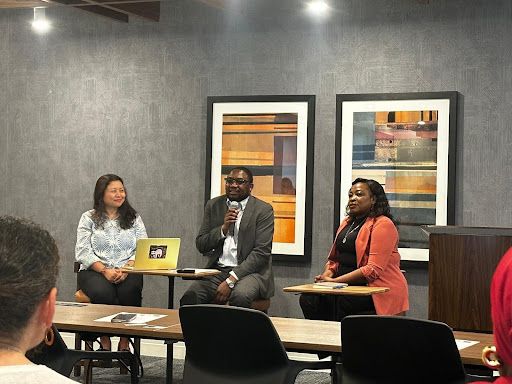
“Abstraction is what allows the world to look away.”
Myra Dahgaypaw
Ahmadi spoke about fleeing Darfur more than twenty years ago. She promised the women, neighbors, and family members who helped her leave that she would continue fighting for Darfur and would not allow their stories to be forgotten. She described building DWAG from that promise, despite uncertainty and displacement, and the pain of watching Darfur once again descend into mass violence after communities were denied meaningful peace, justice, or protection following the genocide of the early 2000s.
Abdulshafi described the emotional burden carried by the Sudanese communities now watching crimes unfold in real time through phones and social media. For the diaspora, atrocities are not distant headlines but intimate losses: videos of destroyed neighborhoods, assaulted civilians, and missing relatives circulate in family networks and community groups.
Behind every statistic, panelists emphasized, are families uprooted, women subjected to violence, children denied schooling, and communities stripped of dignity. A central lesson of the panel: recognition alone is not enough. Naming genocide without dismantling perpetrators’ power, protecting civilians, and ensuring accountability creates the conditions for future atrocities.
Policy, Accountability, and Gaps
The second panel turned to strategy and solutions, featuring Mike Brand, D. Wes Rist, and Dr. Gregory Stanton, moderated by Mona Ali Khalil.
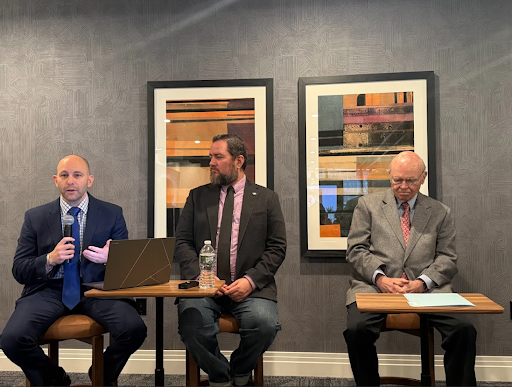
A major theme of the discussion was the disappointing erosion of atrocity prevention capacity within governments and multilateral systems in the last few years. Rist reflected on his time at the U.S. Department of State, which used to have dedicated Sudan teams focusing on civilian protection, early warning analysis, gender-responsive policy, and disability inclusion. The disappearance of these specialized spaces reduces governments’ ability to respond before violence spirals.
Brand focused on the costs of impunity. He argued that many of the atrocities unfolding in Sudan today cannot be separated from the lack of accountability for earlier crimes in Darfur, South Kordofan and Blue Nile. When perpetrators remain armed, politically connected, or internationally tolerated, cycles of violence are allowed to regenerate. Delayed justice, the panel emphasized, is not neutral; it carries consequences such as impunity.
Stanton said prevention is not only about punishment after crimes occur. It requires building political cultures that reject dehumanization, investing in women’s leadership and civil society, and confronting hate before it escalates into organized violence.
The discussion also examined how grassroots organizations are increasingly expected to fill the vacuum left by failing institutions. Local civil society groups are asked to document abuses, support survivors, provide evidence to investigators, advocate internationally, and sustain communities under siege, often while facing shrinking funding and limited access to decision-making spaces.
The panel noted that institutions matter, but pressure matters too. Citizens can help by advocating for stronger foreign policy attention to atrocity risks, pressing elected officials to support sanctions and civilian protection measures, funding credible grassroots organizations, demanding enforcement of existing laws, and refusing to treat genocide prevention as a niche issue reserved for experts.
Ahmadi’s Closing Message: Survivors Are Not Passive
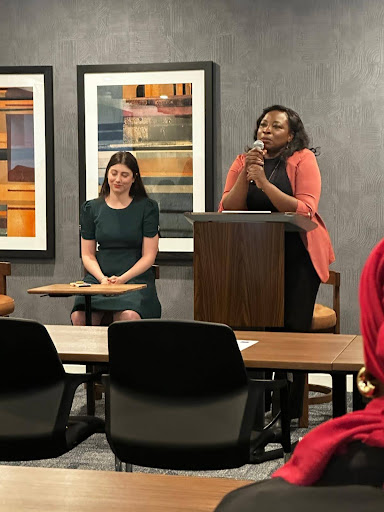
Ahmadi closed the event by challenging the tendency to view those impacted by genocide only as victims or survivors.
Instead, she urged the audience to recognize them as leaders, experts, and agents of change.
“Ending genocide cannot happen without empowering the people facing genocide. The killing, displacement, and violence is the last stage of genocide. If the survivors and civilians are directly involved in prevention approaches, legislative, and accountability mechanisms, the last stage of genocide will never be reached.”
Niemat Ahmadi
She emphasized that survivor-led advocacy is not only important in principle, but it has also already driven real change. From grassroots organizing that helped bring global attention to the Darfur genocide in the early 2000s, to sustained advocacy that contributed to international investigations, sanctions, and arrest warrants against perpetrators, survivor voices have consistently played a critical role in pushing institutions to act.
Her message was clear: meaningful change does not come from outside actors alone. It is driven by those closest to the crisis, when they are given the platform, resources, and power to lead.
Looking Forward
The event was a reminder that remembrance alone is not enough. If Genocide Awareness and Prevention Month is to have meaning, it must inspire earlier action, stronger accountability, and greater investment in those already leading from the frontlines.
For those interested in revisiting the event, watch the recording here: A World Without Genocide: The Case of Sudan.
Please visit DWAG’s website for urgent actions that you can take today to prevent genocide.
Also, visit our co-sponsors’ websites to keep up with their fight against genocide:
- No Business with Genocide
- Genocide Watch
- Alliance Against Genocide
- United Nations Association – National Capital Area
Contact us at policy@darfurwomenaction.org.
DWAG would like to thank Humanity United for providing resources to support this event.