
August 29, 2026
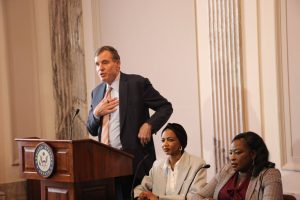
Virginia Senator Mark Warner (D-IN), delivers remarks at April 15, 2026 Capitol Hill Event photo credit: Refugees International
Washington, D.C. – For more than three years, Sudanese civilians have endured a devastating conflict marked by mass atrocities, widespread displacement, attacks on civilians, and grave violations of human rights. The United Nations and Human Rights Watch have documented abuses by both the Rapid Support Forces (RSF) and Sudanese Armed Forces (SAF), including attacks on civilians, widespread sexual violence, and recent hallmarks of genocide by the RSF in El Fasher, Darfur.
As the crisis continues, the United States has an opportunity to move beyond statements of concern and strengthen concrete measures to protect civilians, hold perpetrators accountable and cut off the external support fueling the conflicts. Two pieces of legislation currently before Congress—the Preventing External Aggression and Conflict Escalation (PEACE) in Sudan Act of 2026 in the Senate and the US Engagement in Sudanese Peace Act in the House—could determine U.S. response to the atrocities facing Sudanese peoples.
A Wave of Support for Sudan
The legislative effort brought forth by dedicated US Senators and Representatives comes at a time of increasing US solidarity and support towards preventing the atrocious crimes currently happening in Sudan. The PEACE in Sudan Act of 2026 is led by Senators Jim Risch (R-ID), Chris Coons (D-DE), Jeanne Shaheen (D-NH), John Cornyn (R-TX), and Cory Booker (D-NJ). Senator Coons and Senator Shaheen, senior members of the Foreign Relations Committee, have advocated for Sudan since December 2023 to push for a US Special Envoy and announced the Sudan Accountability Act in 2024/25 to protect civilians and force accountability for war crimes. Senator Risch and Senator Booker, also members of the Foreign Relations Committee, have worked since 2024 to condemn attacks by the RSF and issue statements in an effort to keep Sudan on the radar of US policymakers. In the last month Senator Booker called on Congress to act in Sudan, emphasizing the perilous gap between documented war crimes and the international response, encouraging response before another massacre.
Most recently in July 2026 Senator Risch and Coons issued a bi-partisan statement imploring “the RSF, the Sudanese Armed Forces (SAF), and other actors to participate in good faith to negotiate a durable peace and the flow of humanitarian aid. We also call on foreign backers of the RSF and SAF, including partners in the Middle East, to immediately stop the flow of weapons and resources that are perpetuating this catastrophic war.”
Senator Van Hollen (D-MD) alongside Senator Tim Kaine (D-VA) and other officials wrote a letter to US Secretary of State and National Security Advisor Marco Rubio on August 3rd, stressing the urgent need for action in light of the impending siege of El Obeid. Senator Van Hollen has also continued to urge the United States to leverage its diplomatic and economic influence to prevent UAE support for the RSF, including through discussions with US officials in March.
Senator Mark Warner (D-VA) alongside Senator Tim Kaine (D-VA) and 6 other officials addressed Secretary of Homeland Security Markwayne Mullin and Secretary of State Marco Rubio in a letter sent on August 17th, urging an issue of an 18-month extension and redesignation of Temporary Protected Status for Sudan, continuing and expanding protection for Sudanese people. “The ongoing armed conflict, catastrophic humanitarian crisis, and widespread human rights abuses make the safe return of Sudanese nationals impossible at this time, meeting the legal standard for extension and redesignation of TPS under Sec. 244 of the Immigration and Nationality Act. TPS for Sudanese nationals in the United States remains both a humanitarian necessity and a prudent policy to ensure that individuals are not forced to return to conditions that continue to threaten their safety and well-being.”
On the House side, The US Engagement in Sudanese Peace Act, led by Foreign Affairs Committee members, Representatives Sara Jacobs (D-CA) and Gregory Meeks (D-NY) is cosponsored by 30 other Representatives. Representative Meeks issued a statement in April, marking three years of war in Sudan where he demanded that “The United States must do more to end this war.” Representatives Meek, Jonathan Jackson, and Jacobs are proposing additional legislation (H.R. 8301) RSF Terrorist Designation Act requiring determination on designating the RSF as a Specially Designated Global Terrorist Organization, another vitally important piece of legislation.
U.S. Proposals to Address the Crisis in Sudan
The bipartisan (S. 4726) Preventing External Aggression and Conflict Escalation (PEACE) in Sudan Act of 2026 expands and strengthens the US government’s response to the ongoing human rights crisis in Sudan by:
- Calling on the Secretary of State to examine armed actors for Specially Designated Global Terrorists classification while providing an updated and expanded list of criminal behavior eligible for sanctioning by the President.
- Aiming to hinder economic growth for perpetrators of these crimes by limiting aid to the Sudanese government and requiring transparency with US businesses about the natural resource exploitation of doing business in Sudan.
- Extending authorization for swift appointment of a US Special Envoy for Sudan.
- Updating information sharing avenues by requiring regular reports submitted by the State Department regarding external state/non-state-sponsored violence/asset holding, documenting the atrocities being committed, and encouraging working towards a stronger internal coalition focused on ending the conflict.
- Read more from our partner Genocide Watch.
The House’s (H.R. 1939) US Engagement in Sudanese Peace Act proposes a US government strategy to protect civilians, achieve sustainable peace, and hold perpetrators accountable by:
- Imposing sanctions against those responsible for war crimes/genocide, blocking aid, or violating the UN arms embargo, prohibiting sale of major defense equipment to countries supporting the RSF or SAF, and monitoring state interference in humanitarian aid to Sudan.
- Supporting humanitarian intervention by deriving new strategies to support delivery of sustainable humanitarian assistance, bolstering the position of US Special Envoy for Sudan, authorizing assistance for a multinational force for civilian protection, and supporting greater inclusion participation from Sudanese women and youth in conflict resolution, security sector reform and other important decisions include relief planning.
- Requiring a comprehensive interagency report on any US-made weapon employed in Sudan.
- Read more from the House Foreign Affairs Committee.
Protection and Justice Cannot Wait:
With these unprecedented supportive steps, there are steps the US government should take to support genuine relief. Human Rights Watch and Amnesty International have urged Congress to strengthen accountability provisions by supporting investigations into serious international crimes and the collection and preservation of evidence that can be used in future accountability processes. Congress can also help address the international dimensions of the conflict. Both bills would increase scrutiny of foreign governments’ involvement in Sudan and potential violations of the UN arms embargo. These measures are particularly important as evidence continues to emerge of external military support to parties involved in the conflict. DWAG encourages the US to work with civil society organizations to make as well-informed decisions as possible.
The international community has repeatedly acknowledged the scale of Sudan’s humanitarian catastrophe. Missing is sufficient political pressure and sustained action to match the severity of the crisis. This and all policy is vital to the fight for justice in Sudan with actionable next steps to address gaps and support authentic allyship.
Call to Action:
The United States must develop and pass legislation on Sudan. Write and send your own letter or complete one of the following pre-developed actions:
Contact Congress to support these bills! (via Emgage Action)
Urge your Members of Congress to step up on Sudan. (via ONE)
Speak out for Sudan and urge U.S. leaders to protect civilians, expand the arms embargo, and demand accountability. (via Amnesty International USA)
These opportunities are rare. Passing meaningful legislation would not solve Sudan’s crisis overnight, but it would demonstrate that the United States is prepared to match its commitment to human rights with concrete action.
Now is the time for Congress to step up for Sudan. Members of the public can contact their representatives and urge them to support meaningful legislation that protects Sudanese civilians, advance accountability, factor in civil society organization advocacy and help build a path toward lasting peace, echoed by demands for collaboration with civil society organizations.
Want to get more involved? Message us at campaign@darfurwomenaction.org to learn more about next steps for Sudan. DWAG welcomes engagement from individuals, educational institutions, businesses, organizations and all other aspiring or established advocates. Opportunities include guest speaking, institutional partnerships, advocacy campaigns, and participation in upcoming events. We also seek to collaborate with U.S. policymakers in advancing effective frameworks for humanitarian assistance and support for the people of Sudan.
With Gratitude,
Darfur Women Action Group