Darfur and Sudan: News Update

DArf
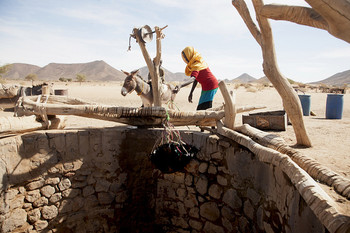
A women travels miles just to collect a  bit of water from this well. Image from Unamid

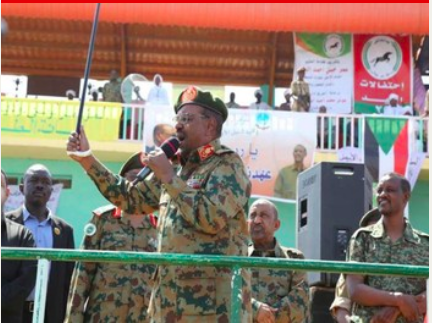
President Bashir, has been rhetorically reiterating the state’s supposed desire to bring “Peace to all states in Sudan”, yet violence against innocent civilians by the state speaks the volume of his political will to do so:

  • On March 22, the head of the Golo Veterinary Unit in Central Darfur “was beaten and had his head shaven by agents of the National Intelligence and Security Service after he refused to allow the sale of unauthorized meat to one of the butchers in the market”. Veterinarians in the area have gone on strike to protest this injustice.
  • Those hiding from conflict in the remote caves and valleys of Jebel Marra are pleading for rapid interventions for the rampant spread of diseases in the area. Ranging from measles to pneumonia to dysentery, these diseases have already killed dozens and infected hundreds. Though not an example of physical violence, the government’s barring of humanitarian aid for its own citizens is just another example of abuse of its own people.
  • On March 18, meetings began in Paris between Sudan Call alliance of opposition parties, and representatives of the government of France, Britain, Norway, the EU, and the USA. Sudan Call is urging these nations to stop dialogue with the current Sudanese regime, to keep Sudan on the list of state sponsors of terrorism, and to support the people of Sudan in transitionary efforts towards a democracy.


On top of the ongoing violence against innocent civilians, the citizens of Darfur continue to face a plethora of other hardships:

  • The extreme lack of water in East Darfur is a current major crisis. The destruction and disruption of water sources has not been addressed so far, and many callers told Radio Dabanga that there is an “extreme lack of water”. Residents from Abu Sineit area said that they must make a six-hour trip to find water. This is having a gravely negative impact on civilians, livestock, and agriculture.
  • Economic hardship rages on in Sudan as hyperinflation remains another major issue. High prices of food, fuel and medicine, as well as limits on cash withdrawals are devastating many, due to a liquidity crisis within the government. Many report inability to access their February salaries, hence they can’t meet the basic needs of their families such as food and medicine.

The same al-Bashir regime that orchestrated the genocide in Darfur is currently ordering brutality against peaceful protesters in Sudan. Your voices are urgently needed to expose al-Bashir’s crimes in Darfur and across Sudan.  It takes only one action to contribute to ending genocide in Darfur and the unprecedented carnage across Sudan.

If you can share this with 5-10 people in your network and ask them to do the same, you will make a difference. Use your voice to urge the Us government not to normalize relation or delisting Sudan from states sponsor of terrorist until there is a lasting peace in Sudan

With our collective effort we can make a difference.  We can end it.

Please also check our STAND with Sudan campaign  and take one of the actions if you have not done so yet.

Like us on FBTwitter and Instagram


Another Ill-advised Congressional Trip to Sudan

We were alarmed to learn that yet another U.S. Congressional delegation visited Sudan on the weekend of March 16th, 2019.  If this delegation, whose trip is facilitated by the Humpty Dumpty Institute (HDI), is looking to build upon least year’s Congressional visits to Sudan sponsored by HDI, they are sending a wrong and dangerous message to President Omar al-Bashir and his government.  The American people deserve an answer.

They should have numerous questions regarding HDI, as it seems that the organization’s primary purpose has become taking politicians to Sudan and working on rebranding the genocidal face of the regime in Khartoum while the Sudanese people themselves reject Mr. al-Bashir.  HDI stopped posting financial information on its website in 2011. We also have questions regarding the funder of the previous trips, Bash Pharma.  The delegations visited a Bash Pharma manufacturing facility, and we would like to understand better the role they are playing.

Last year, two HDI-sponsored delegations visiting Sudan met with political leaders in Khartoum.  During these visits, the delegation was hosted at the house of the First Vice President, at the National Assembly, at the home of the Chargé d’Affaires, and with the National Intelligence and Security Service.  While there, they were undoubtedly told about all the steps the government was taking to end the violence, make reforms, and return the country to prosperity.  The delegation worked with the al-Bashir regime to open up their banking system, remove further sanctions, and be removed from the State Sponsors of Terrorism list.  History is not on the side of this being constructive.

When the world was up in arms about the genocide in Darfur, Mr. al-Bashir promised to reduce his attacks and promised reforms.  He falsely convinced the world that the genocide was over, and used the interim time to gain greater control of the media and the messages the world would hear.  Once most economic restrictions were lifted, however, Mr. al-Bashir returned to violent methods of rule.  The number of displace persons has risen dramatically over the past few years. Mass rapes, theft and murder have not only returned to Darfur, but have spread to other regions.  Three million displaced Sudanese remain under attack and too afraid to return home because of insecurity.  The policies of normalization have only emboldened this regime.

Luckily, the people of Sudan understand what American politicians do not: This violent regime will never change, and the time for new leadership has come.  In December, nationwide protests calling for Mr. al-Bashir to step down erupted, and despite an unconstitutional state of emergency aimed at quelling dissent, they continue to grow.  The government has responded the only way they know how—with violence.  Dozens have been killed, thousands jailed, and reports of beatings and torture are common.  Doctors have been targeted, six hospitals have been attacked, members of the free-press are jailed, and brave human rights defenders and lawyers are arrested regularly.

This is not a regime that will change and any policy that aims to work with it is horribly misguided.  U.S. voters need to understand why yet another congressional delegation is visiting Khartoum and why they are pushing to give Mr. al-Bashir more power.  Voters also need to know why these delegations are not visiting Darfur, Blue Nile, and South Kordofan where the people there will tell them a much different story than the ones they are being told in Khartoum.

Press reports regarding the current and past congressional trip to Sudan can be found here:

http://www.sudantribune.com/spip.php?article67195

http://www.sudantribune.com/spip.php?article67230

http://www.startribune.com/sudan-secures-300m-loans-from-regional-fund-amid-protests/507265372/


Details of the last year’s trips can be found on HDI’s website here:

http://thehdi.org/congressional_delegations/sudan_delegation_july_2018.html


Mike Hall

Policy Advisor

Darfur Women Action Group

darfurwomenaction.org

News Update- Week of March 10th

Keep Your Eyes on Darfur

pic darfur

While the world’s attention turned to the government of Sudan’s violent response to the nationwide protests, massacres, brutal rapes and violent attacks on innocent people of Darfur have been going unnoticed. Those who have been displaced 15 years ago in Darfur are still facing systematic attacks and rape of civilians every day.

  • On March 14: Three students from Sheikh Yousef Mustafa Koran Institute were victims of armed robbery in South Darfur. After exchanging blows with one robber, Hanafi Ismail was fired at and killed instantly, while the other 2 students were seriously wounded. One of the robbers was a corporal in the Sudan Armed Forces.
  • Last week, three young women and girls were repeatedly raped at gunpoint by militiamen in North Darfur while collecting firewood. One girl (14) was also “beaten, whipped, and verbally humiliated”. The Incident was reported to Kutum-area police, but perpetrators have not been pursued nor arrested.
  • On March 13: Six displaced persons were massacred in the Ardamata camp in West Darfur while collecting straw. The Darfur Media and Journalists Associations held the government responsible and demanded an investigation to bring those responsible to justice.
  • Credible sources from the ground estimate that more than 150 women are currently imprisoned for participating in protests in Sudan. While a portion of these young women were released from Omdurman Women’s Prison in Sudanlast Tuesday, there is a lack of information as to how many remain detained.
  • On March 9: Nine women were arrested for participating in peaceful anti-government protests and sentenced to one month in prison and 20 lashes, though the latter punishment was appealed and reversed.

The same al-Bashir regime that orchestrated the genocide in Darfur is currently ordering brutality against peaceful protesters in Sudan. Your voices are urgently needed to expose al-Bashir’s crimes in Darfur and across Sudan.  It takes only one action to contribute to ending genocide in Darfur and the unprecedented carnage across Sudan. If you can share this with 5-10 people in your network and ask them to do the same, you will make a difference.

With our collective effort we can make a difference.  We can end it.

Please also check our STAND with Sudan campaign and take one of the actions if you have not done so yet.

Like us on FB, Twitter and Instagram.

Thank you for your support.

Niemat Ahmadi

International Women’s Day


Darfur Women Action Group Observes International Women’s Day

Every day we hear stories of resilience, tragedy and horror, and yet, international institutions continue to betray and ignore the women of Darfur. Your voice can change this.

Dear supporters,

On this International Women’s Day, we would like to bring your attention to the daily suffering of the women of Darfur—and to honor their resilience.  Despite the fact that Darfuri women are still under genocidal attack and continue to be victims and survivors of brutal and systematic mass rape, they continue to persevere and serve as the lifeblood of their communities.  Today, on International Women’s Day, we need to let them know that they are not alone, and that there is hope.

Darfur Women Action Group strives to changes the way the world responds to crimes committed against women in Darfur and we need your help to do so.

Today, we will honor some of these brave women by sharing their story.  On February 5th, two women, three girls and two boys from the Zamzam camp for displaced Sudanese set out on a 13-kilometer journey to collect straw to make bed mats, hats, baskets and other items essential to daily living.  Being able to complete this task safely is something many of us would take for granted.  But in Darfur, common activities like this are fraught with risk, and is all too common, this one ended in tragedy.

A sheikh of Zamzam camp for the displaced, near to El Fasher, capital of North Darfur, told Radio Dabanga that on Monday, a group of herders attacked two women, three girls, and two boys while they were collecting straw at Um Hashaba area, 12 kilometres west of Zamzam camp.

The attackers beat the boys, took the women and girls at gunpoint, and raped them repeatedly from 4 pm until 10 pm. 

The sheikh said the incident was reported to the police and the victims given medical treatment. 

A patrol under the leadership of the Commissioner of El Fasher went after the culprits on Tuesday, but there are no reports of arrests.” 

We were horrified by the news reports of this incident (https://www.dabangasudan.org/en/all-news/article/women-girls-gang-raped-in-north-darfur-attack).  These women and children will be expected to pick themselves and find a way to continue to persevere in the face of the type of adversity that is unimaginable.  They need to know the world is watching.  They need your support.

What is happening in Darfur?

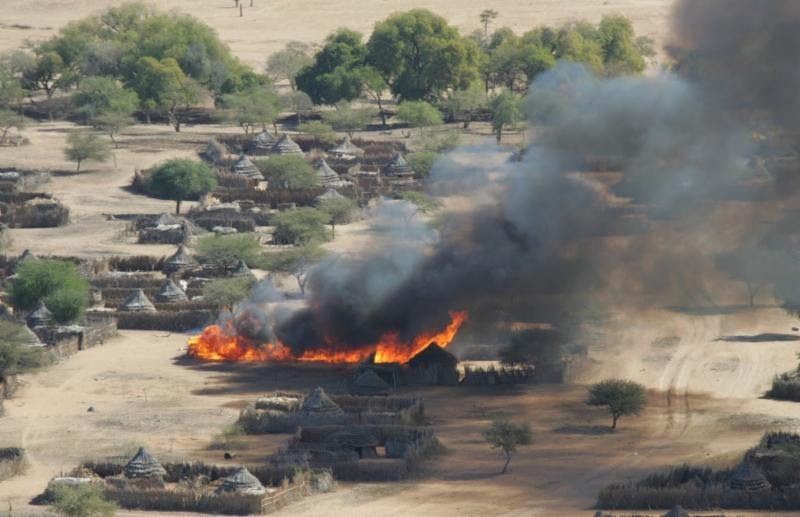
For more than 15 years, the Sudanese government’s military forces and their allied militia, the Janjaweed, have carried out systematic attacks against the Darfuri people based on their ethnicity. They have bombed villages, abducted civilians, looted private property, and used rape against women and girls as a weapon of war.

Rapes in Darfur are well-planned and deliberately orchestrated attacks to tear apart families, break down leadership structures, and leave long-term social, emotional, and physical scars on entire communities. All of these tactics are used by the Sudanese government and its allied militia to perpetuate genocide.  No research has been conducted to determine the exact number of women raped and the impact of sexual violence on women and girls. Regrettably, not a single perpetrator has been brought to justice.

As a result, more than 3 million Darfuris were forced to leave their villages for internally displacement camps or ones located in Chad.  More than 80% of these people are women and children.  The government of Omar al-Bashir has blocked much of their access to humanitarian assistance, and they have little access to education or protection.

You can help.  The saddest part of all of this is that it can be stopped, but the world community refuses to act.  World leaders are convinced by the Sudanese government’s narrative that the crises in Darfur is over, even though news reports confirm that the violence in Darfur is progressively getting worse. In November alone, 50 villages in one region were burned, displacing 50,000 people.  In February, the government declared a state of emergency allowing unfettered ability to arrest anyone who questions their authority.

If your elected leaders knew that you were aware of the situation in Darfur, they might change their policies.  Currently, Western governments are removing sanctions, allowing al-Bashir to travel freely, reducing peacekeeping forces, establishing new diplomatic relations, and taking other steps to normalize relations, But we know that the more freedom al-Bashir attains, the more violent he becomes.

 Please join us this month to speak up for the women in Darfur, empower survivors, and seek justice for victims. 

 How can you help?

Please take the following actions to help DWAG:

  • Share the story of the women and girls of Zamzam and educate 5-10 of your friends and family. Please let us know their reactions. Report back to us via Facebook, Twitter, or via email at policy@darfurwomenaction.org.
  • Support our Stand with Sudan campaign by contacting your member of Congress, the United Nations Security Council, or writing a letter to the editor of your local newspaper. Follow this link for more information: http://www.darfurwomenaction.org/stand-with-sudan/
  • Share our statement on social media and use the hashtag #StandWithSudan.
  • Donate to our organization to support our “Women Empowering Women” project by following this link: http://www.darfurwomenaction.org/donate/
  • Organize a screening of our “Violence Against Women” video to educate more people. Contact us and we will send you a link!
  • Organize a fundraising event for DWAG. We will give you all the tools to help us reach our fundraising goals.
  • Invite DWAG to speak at your school, congregation or community in order to educate more people about the situation in Darfur.

“Every day I hear stories of resilience, tragedy and horror. And yet, international institutions continue to betray and ignore the women of Darfur.  Together we can change this.”

Niemat Ahmadi, DWAG President.


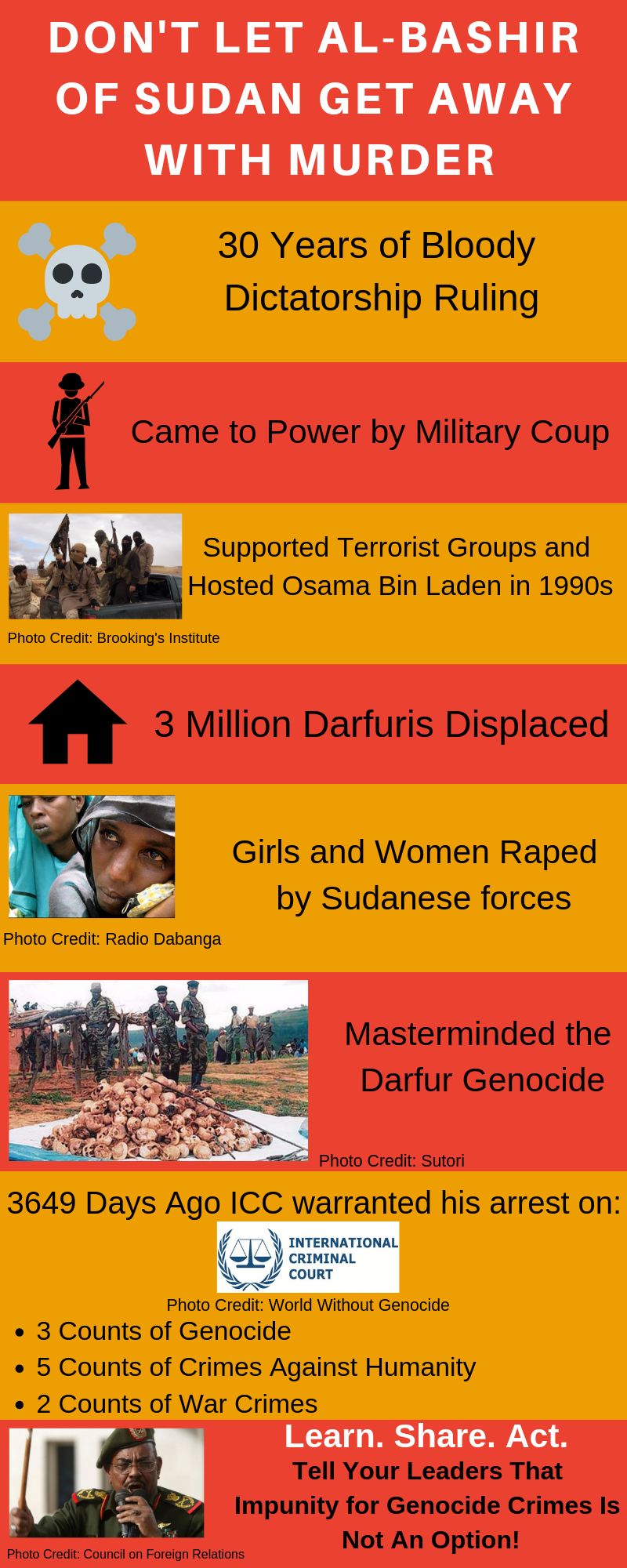
Don’t Let al-Bashir Get Away With Murder

Dear Supporters,

Ten years ago today, on March 4th the International Criminal Court (ICC) issued the first arrest warrant for President Omar al-Bashir of Sudan. The initial charges were for war crimes and crimes against humanity. However, on July 12, 2010, the ICC issued a second warrant this time inducing the added charge of genocide. The ICC cited Sudan’s genocidal campaign in Darfur, which has been ongoing for more than 15 years and continues unabated to this day.


For more than 15 years, the Sudanese Government’s military forces and their allied militia (the Janjaweed) have carried out systematic attacks against the Darfuri people based on their ethnicity. They have bombed villages, abducted civilians, looted private property, and used rape as a weapon of war against women and girls. As a result, over 4 million Darfuris have been affected, and over 3 million have been forced to leave their villages and continued to live in makeshift camps within Sudan and Chad. To date, over 3 million people remain in these camps with limited access to humanitarian assistance, education, health care, and food.


The impunity must end! President al-Bashir’s continued freedom from liability for such heinous crimes serves as an affront to our international human rights, humanitarians’ laws, and the genocide convention that our world leaders repeatedly vowed to uphold.


We must speak up, continue to expose al-Bashir’s crimes, and hold our leaders accountable for ignoring them. We urge the United States government not to normalize relations with Sudan as normalizing with Genocidaires is equal to normalizing genocide.


In the coming days, we will be sharing information about the situation and will give you the opportunity to take action.


We urge you to join us on social media to denounce this criminal and urge our leaders not to let Bashir get away with murder.


With Gratitude,

Niemat Ahmadi, President

Darfur Women Action Group’s team

The Trump Administration and Sudan: Another Charlottesville Moment


Photo Credit: Sudan Tribune


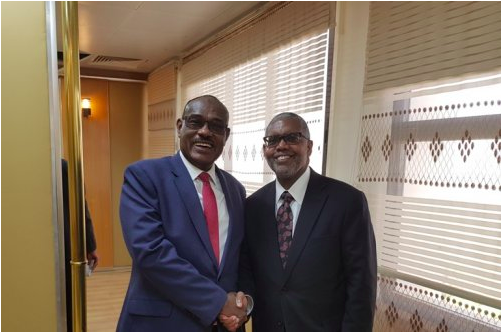
According to the Sudan Tribune, the Special Assistant of the U.S. President and Senior Director for African Affairs of the National Security Council, Cyril Sartor, met on Monday with Sudanese Assistant President Faisal Hassan Ibrahim Ali, at the presidential palace in Khartoum to discuss U.S.- Sudanese Relations.

Despite the fact that Sudanese President Omar al-Bashir has conducted a decade-long genocide, and that peaceful, nationwide protests calling for al-Bashir to step down have erupted, this meeting reaffirmed America’s desire to normalize relations with the oppressive Sudanese regime even if it costs human lives. This, of course, is of little surprise considering the Trump Administration’s friendly foreign policy towards dictators of all sorts.

But the way Mr. Sartor described the situation not only hearkened back to President Trump’s regrettable “both sides” comments following the violence, including a murder, by white supremacists in Charlottesville but demonstrated just how comfortable the U.S. administration is with using and supporting banana republic tactics.

After saying that “no external solutions will be imposed on Sudan,” Mr. Sartor stressed the importance of “the Sudanese government’s respect of the citizens’ right to peaceful expression, while demanding at the same time the other side to abide by the same peaceful commitment.”

Mr. Sartor’s comment came as a shock to the Sudanese people and those of us working on human rights in Sudan.

The violence by the al-Bashir regime against this peaceful protest is well documented.  More than 50 protesters have been killed, well over a thousand jailed, and reports of torture are common.  27 doctors have been jailed, six hospitals have been attacked, tear gas has been used in extreme fashion—even leading to death, the free media has been silenced, and journalists have been jailed.  But Mr. Sartor and the Trump Administration want to make sure that “both sides” act peacefully.  In his 30 years of ruling, al-Bashir has never acted peacefully.  This is a man with one of the poorest human rights records in history.

Of course, this sort of rhetoric is like gold to al-Bashir who uses it to back his false claims of violence against his government.  Experience shows that the more legitimacy he gets from the U.S., the more violent his regime becomes. This includes the free pass that President Bashir received from the previous administration that is now directly impacting peaceful people who have grasped an opportunity to take control of their lives.  The U.S. policy towards Sudan has been a mess for years, and has only emboldened al-Bashir to kill his own citizens. This policy needs immediate attention and redirection, and it needs the truth on its side to be successful.

Darfur And Sudan: News Update

Photo credit: Radio Dabanga

As peaceful protesters call upon Sudanese President Omar al-Bashir to step down from office, this is his reaction:


  1. Dozens of innocent Sudanese protesters have been killed in the last month by the Sudanese government.

Instead of peacefully walking away from office, President al-Bashir is brutalizing

his people into submission, but his plan is not working so far. Sudanese citizens, especially millennials, are taking to the streets of Khartoum to rally for his exit.


  1. Sudanese police are attacking their own people.

They are throwing tear-gas at protestors in response, particularly at the University students and in a hospital.


  1. A doctor was killed in cold-blood for attempting medical treatment of wounded.

Witnesses report that the doctor was trapped inside a house with protestors providing them with medical help when police forces began using tear gas to force them out of the house. The doctor decided to go outside with his hands raised, signaling that he was approaching peacefully. He asked if he was able to talk with the soldiers and they agreed, telling him to continue to walk towards them when they fired.


  1. The Sudanese government is trying to manipulate the news cycle to leave the outside world in the dark about daily violent attacks.

Sudanese government revoked journalists accreditation and arrested 38 of them for ‘fake news.’ Twitter, Facebook, and WhatsApp are blocked by Sudanese government too, however tech-savvy millennials are circumventing the government’s VPN system to continue posting scenes of the protests for the world’s viewing.


  1. The Sudanese government is taking away citizens’ human right to education.

Universities and schools closed by Sudanese government for a ‘state of emergency.’

University professors from Khartoum University have been arrested for attempting to participate in the protests, the rest of them had been blocked from joining and were trapped in university buildings surrounded by security forces for three hours.


Violence Continues in Darfur Under the al- Bashir Regime – Violent attacks update Oct. – Nov 2018

From Mid October 2018 through early December 2018, there have been over 40 violent incidents against the Darfuri people in Sudan. 40 people have been killed while 91 have been injured or made into victims of rape, robbery, or property destruction. Government backed militias and the government forces were the main perpetrators of violence against Darfuris. The overwhelming majority of the victims are women and children.


On the week of November 10, sixteen villages in Jabe Marra have been completely destroyed and burn to the ground,  leaving over 50,000 people without homes or any survival means


The Sudanese military forces have used excessive violence against Darfuris. On November 15, two children were killed in a shelling by the Sudanese Armed Forces near East Jeble Marra, South Darfur. In another separate incident, the Sudanese Air Force killed a displaced woman as they bombed her village located in Central Darfur


In most instances, there are multiple attacks in one day. In one incident, on October 4, four armed herdsmen trespassed with their cattle on a farm being attended by two women. The women went out to drive the cattle off their property, however the herders confronted them and shot them. The two women were seriously injured and taken to receive medical treatment. The very same day, another report came in of a man who was gunned down by armed herdsmen. The herdsmen killed Salim Ahmed in cold blood before stealing his camel. They then fled the scene with Ahmed’s property, leaving Ahmed dead.


These acts of violence are not random or isolated incidents. These are a part of the well-orchestrated and systematic genocidal attacks by regime in Khartoum against the people of Darfur that has been going on for more than fifteen years. The victims are consistently unarmed civilians who are farmers, merchants, students or professionals merely trying to earn their daily living. Its president al-Bashir policy of indifference and aggression intended to exterminate the people of Darfur and to take over their lands. Prior to this DWAG have documented over 200 violent attacks during the first half of 2018 with similar trends.


While the government of Sudan perpetrates these heinous crimes, the international community’s response is deafening silence. For this reason, President al-Bashir has been emboldened and continues to perpetrate these horrific crimes with impunity.


Today there are over 4 million genocide victims who have been driven out of their homes and have yet to return home for fear that their lands have been confiscated. Over half a million people have been killed and justice has yet to be achieved for them. Countless women and girls have been raped and are still struggling without any trauma counseling or psycho-social support.


President al-Bashir is the only sitting head of state wanted for the some of the world’s most serious crimes, but he is yet to be held accountable. Therefore, we at DWAG refused to be silent or let al-Bashir get away with murder. We must continue to speak, expose the crimes and demand our leaders and our international institution fulfil their responsibilities and make it clear to President al-Bashif that impunity for genocide is not an option. Without proper justice, accountability and genuine peace, the crimes in Darfur and Sudan will not be resolved sustainably.


We call on the US government to demand that al-Bashir must cease attacks on civilians, and all violation of rights in Darfur and across the Sudan. We call on the US to impose targeted sanctions, assets freezing, and travel ban on Sudanese officials responsible of committing crimes in Darfur and across Sudan. The United nations Security Council members, like the United States, have an obligation to protect civilians and pursue justice for the victims in Sudan. Without proper justice and accountability, the crisis in Darfur and Sudan will not be resolved and a sustainable peace will not be attained.

Justice Delayed is Justice Denied

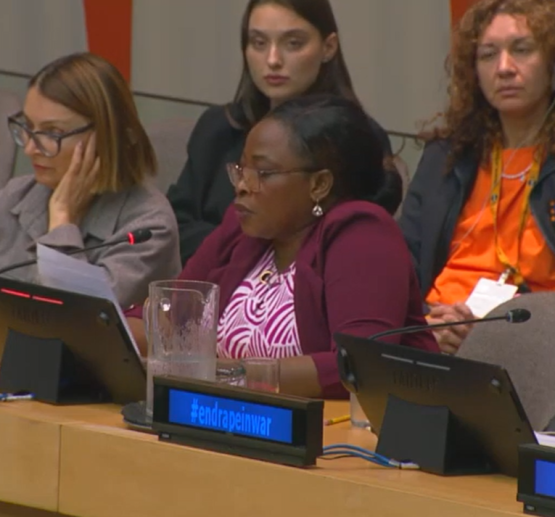
On Friday, December 14, Darfur Women Action Group (DWAG) members traveled to New York City to attend an International Criminal Court (ICC) briefing to the United Nations Security Council. The briefing, delivered by ICC Chief Prosecutor Fatu Bensouda, was on the 28th report on the situation in Darfur. DWAG members also had the opportunity to meet privately with Chief Prosecutor following the briefing.


The report began with Prosecutor Bensouda reminding the member states that Sudanese President Omer al-Bashir and other Sudanese government officials have multiple arrest warrants against them, comprising over 60 counts of war crimes and over 50 counts of crimes against humanity. Furthermore, Prosecutor Bensouda emphasized that there is growing evidence showing al-Bashir is responsible for the crimes that were committed in the past two decades as well as the ones that are still occurring. The report also highlighted the recent escalation of attacks and increased civilian casualties in the Jabel Mara region, an area in which atrocities are regularly being committed against the people of Darfur.


“I continue to be concerned about sexual and gender crimes in the Jebel Marra area,” said Prosecutor Bensouda. “The government (of Sudan) continues a policy of aggression and antagonism.”


Prosecutor Bensouda then voiced the ICC’s dissatisfaction with member states’ failure to enforce the Rome Statute. She pointed out that some member states had failed to arrest al-Bashir and bring him to justice while he was visiting certain countries. She then demanded that the UNSC must request an explanation from ICC member states who fail to uphold their legal obligation to the ICC.


Prosecutor Bensouda urged the need for UNSC members to support the ICC and stressed that the people of Darfur must not wait any longer to receive justice. She concluded her address with a call for the UNSC to take concrete action that will hold criminals accountable and bring justice to the victims. “Justice delayed is justice denied,” said the Chief Prosecutor in her final statement.

Attending member states had the opportunity to state their positions in response to the ICC Chief Prosecutor’s report. The overwhelming majority of the Security Council members expressed support of the Chief Prosecutor’s report, raised concerns about the future of the internally displaced people (IDPs) in Darfur and expressed their country’s dedication to the ICC’s work in Darfur. Nations, such as the United Kingdom, France, Sweden, Bolivia, Côte d’Ivoire and the Netherlands, reiterated their government’s commitment to the ICC, to the rights of the people of Darfur, to justice, and have echoed the Chief Prosecutor’s call for the need to bring indicted parties to face justice at the ICC.


There were a few state representatives who offered contradictory remarks, such as Ethiopia, Russia, China, Kuwait and the United States, most of who are not even party to the ICC. Nonetheless, they have not denied the fact that there are atrocities being committed in Darfur and there is a need for action to resolve the situation.


Sudan’s Ambassador to the UN, in an attempt to obfuscate the issue, offered the most controversial, unethical and unprofessional statement in response to the Chief Prosecutor’s report. The Sudanese representative stated that Sudan complies with the Geneva Convention, but failed to offer contradictory evidence against the ICC accusations.Instead, the Sudanese representative used false statements to attack and discredit the ICC as an institution.


Following the briefing, one of the Sudanese diaspora members said, “for Sudan to attack the ICC is not a surprising act. We must be reminded of the fact that this is a regime committing genocide against its own people. It’s just one of many tactics Sudan has employed to divert the attention from their own crimes. As was echoed by the office of the prosecutor’s team, “the Court will not be distracted by the baseless attacks being pushed by Sudan”.


Both the the prosecutor’s team and the Darfuri diaspora have agreed that their focus should not be on the government of Sudan’s verbal attacks on the ICC but on the crimes Sudan is committing every day as well as the case for accountability, no matter how long it takes.


Following the briefing DWAG members met privately with Prosecutor Bensouda. She stressed the fact that victims’ voices must be heard and has assured the members of the affected community that impunity for these serious crimes is not an option. She emphasized that her office will remain committed and will do everything in its capacity to ensure accountability for the perpetrators and justice for the victims in Darfur will be realized. The Sudanese diaspora, justice advocates and the members of the affected community expressed appreciation to the Chief Prosecutor and her team for their tireless effort and reiterated their unwavering commitment to continue to fight for justice. Activists, survivors, and DWAG members alike will continue to voice support for the Chief Prosecutor’s office, regardless of any obstacles Sudan and its allies attempt to present.


“No one can commit crimes of this nature and then not face judgement, no matter who you are, or what country you are in,” said Prosecutor Bensouda. “You must face the consequences.”


“In the face of genocide, impunity must not be tolerated, and no one should expect the people of Darfur to relinquish their rights to pursue justice for crimes and the suffering they continue to endure, said Niemat Ahmadi, President and Founder of DWAG.

DWAG believe we must stand firm and rally our supporters to fight against impunity.

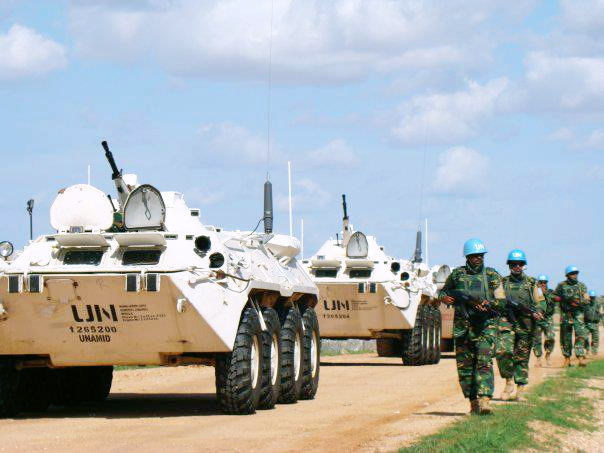
UNAMID Withdrawal from Darfur and the Future of Darfuris


As the situation in Darfur remain dire, attacks on civilians have not been halted and millions remain in camps. The United Nations/African Union Mission in Darfur (UNAMID) has decided to withdraw from the region, adding another load of fear and uncertainty to the plight of Darfuris. On December 19, the Sudanese Parliament urged the international community to support them and stressed the significance of communicating with the United Nations in a spirit of negotiation and agreement to end the mission of the joint peacekeeping forces in Darfur (UNAMID).

The joint meeting of the National Committee to facilitate UNAMID’s exit with UNAMID and the UN country team was held in Khartoum. The meeting discussed government plans and visions to support the alleged stability in Darfur, the transition from humanitarian work to reconstruction and development, background of current phase requirements and arrangements related to the implementation of UNAMID exit strategy.

Further, according to Radio Dabanga, the spokesman for the Ministry of Foreign Affairs stated the meeting reviewed the roadmap proposed by the UN country team in Sudan and a 5 + 5 committee was agreed to include representatives from the government, the United Nations and UNAMID to follow up the exit process and address any challenges that may arise in implementation.

The decision of the government of Khartoum to end UNAMID mission in the region means not only they disregard its existence, but they also deny the necessity of protecting the vulnerable victims of al-Bashir’s attack in IDPs camps and resolving the conflict between the concerned parties.

If the UN falls for the bait and decide the complete removal of UNAMID forces in the region, Darfuris will be left to face a serious risk in which perpetual violence and killings will continue to impend over the region.

The united nations have already failed the people of Darfur for not holding Sudan accountable or resolving the crises and now with UNAMID’s withdrawal, it will give the government of Sudan a free pass to commit more crimes with impunity and no one to witness.