Mass Onslaught of Sexual Violence in Tabit (North Darfur): UNAMID Declares it Finds “No Evidence”

For over a week reports from Darfuris in the Tabit area (45 kilometer southwest of el-Fasher, North Darfur) have provided detailed accounts of the mass rape of girls and women by members of Khartoum’s regular armed forces (Sudan Armed Forces, SAF) on Friday, October 31 – through Saturday November 1. The assaults were in retaliation for the unexplained disappearance of an SAF soldier, with civilians in Tabit held responsible without evidence (it is unclear whether the missing soldier has been found). The accounts have been unusually detailed, from a growing number of sources, even as the event itself is without recorded precedent in the almost twelve years of the Darfur conflict. While the Janjaweed and other militia and paramilitary forces have many times been reported to have engaged in mass rape, and individual members of the SAF have been guilty of rape, never before has an entire SAF army unit engaged in an orgy of sexual violence, directed against an entire non-Arab/African village population.

[NB: All dates and time references appear in bold throughout; all emphases in quoted material have been added—ER]

Yet despite the overwhelming number and consistency of reports from Tabit and now nearby IDP camps, UNAMID declares today that,

None of those interviewed confirmed that any incident of rape took place in Tabit on the day of that media report. The team neither found any evidence nor received any information regarding the media allegations during the period in question.

Darfuris in Tabit are reported to be understandably shocked and uncomprehending, and with good reason. The conclusion of the UNAMID “investigation” is a travesty, a transparent capitulation before the show Khartoum ordered to be prepared for investigators when they finally arrived in Tabit. We gain a much better sense of what is to be found in Tabit from the Coordination Committee of Refugees and Displaced Persons in Darfur:

A delegation of five members of the Coordination Committee of Refugees and Displaced Persons in Darfur had also visited the village: “We just returned from Tabit on Friday [November 7] with a delegation, after two days of investigation. There we met 60 women and girls, we looked into their eyes while they told us they were raped by soldiers from 8 pm [on Friday, October 31] until 5:00am [on Saturday, November 1]. (Radio Dabanga [Tabit] 11 November 2014; full text of this crucial dispatch appears here as Appendix One and at https://www.radiodabanga.org/node/83429)

Critically, what the press release does not indicate is that a UNAMID investigative team reached Tabit on Tuesday, November 4 about 5:00am [it is not yet fully clear whether it is local time being reported] and was able, for perhaps ten minutes, to interview civilians at the Tabit transportation center; the four men confirmed the essential elements of what has been reported by Radio Dabanga, Sudan Tribune, and others (see below). The interview was interrupted by Military Intelligence, which roared up to halt the interview and engaged in a half-hour discussion with the UNAMID personnel, according to the men that had just previously been speaking with UNAMID themselves.

None of this is reflected in a UNAMID press release of the following day (Wednesday, November 5), which declared only that an investigative team had been turned away before reaching Tabit—thereby freeing UNAMID from confronting or revealing the information that had in fact been gathered in the brief interview in Tabit itself. Moreover, there were two investigative teams: one dispatched from Shengil Tobaya on Tuesday, November 4 to Tabit itself, but another on Wednesday, November 5 to ZamZam displaced persons camp outside el-Fasher; that investigative team departed from el-Fasher. UNAMID has chosen to conflate these two efforts in its statements, creating a deliberate confusion. UN Spokesman Dujarric in New York only partially clarified some of this in comments made today (November 10, 2014), but not in a way that makes sense of the UNAMID claim that they were turned away from Tabit by a military checkpoint before reaching the town. As one astute and highly informed observer informed me (email received November 10):

The [UNAMID investigative] patrol was sent back [from Tabit] to Shengil Tobaya on Tuesday[November 4]. But [this] proves that [the UNAMID patrol] passed the border between South and North Darfur and the transportation centre [in Tabit] before they could have reached the military checkpoint of Tabit, just north of Tabit [town]. Shengil Tobaya is south of Tabit and the military garrison is north [of Tabit]. [The] Tabit military base coordinates [are] 13.313832 | 25.087945: 1.5km north (April 2014) or 0.5km north [currently].

The upshot here is critical: if the UNAMID investigative team did encounter an SAF military checkpoint, it would have been after the conversation reported by multiple witnesses as having occurred in Tabit town itself. None of this is reported by UNAMID.

Even more consequentially, the press release does not note or explain key elements of he investigation revealed in an extraordinary dispatch by Radio Dabanga (“Denial of Darfur Rape Cases Shocks Tabit Victims,” November 11, 2014, https://www.radiodabanga.org/node/83429):

[The UNAMID press release] did not mention that its verification team was accompanied by the government’s security officials.

Indeed, at one point the Radio Dabanga dispatch reports the observation of a UNAMID team member:

According to a UNAMID officer … national security staff, police forces, and [even] military personnel accompanied the convoy of the UN [UNAMID] delegation. “I think that every UNAMID staff member was accompanied by at least three people, from the security, police, or military. No one could speak freely to anyone. When we asked some people in Tabit, they only answered: ‘You should speak to the army commander and the authorities.’” UNAMID confirmed that it also interviewed the local Sudanese Armed Forces (SAF) Commander during its visit.

Given the extreme risk of witness intimidation, this was deeply thoughtless or irresponsible—or more likely both—on the part of the UNAMID investigative team, and reflects almost total incomprehension of what the people of Tabit would have felt being interviewed. The Radio Dabanga dispatch goes on to note:

Prior to the arrival of the UNAMID delegation in Tabit and surrounding settlements, the commissioner of Tawila locality, Alumda Alhadi Abdallah Abdelrahman, openly threatened the population that any person who would speak to UNAMID about the rape, “would face the consequences.” “No one even dared to speak up to UNAMID, they just had to deny everything in front of them,” several attendants explained to Radio Dabanga.

In short, the press release of today [Monday, November 10] is speaking of a UNAMID investigation that was conducted after Military Intelligence (MI)—long the regime’s security “muscle” in Darfur—had had a full week in which to sanitize the crime scene and terrify any potential witnesses with threats of unspeakably brutal retaliation if any corroborated what had been reported from Tabit in the preceding days. And then to make sure that no one dared to speak the truth, MI assigned a team of military or security personnel to every investigator.

In one sense, this is not surprising, although it is out of the ordinary. Khartoum’s usual response is simply to deny access, a denial that UNAMID characteristically accepts with a shrug. But the Friday, November 7 declaration by Zainab Hawa Bangura, the United Nations Special Representative of the Secretary-General on Sexual Violence in Conflict, raised the stakes for all concerned: Khartoum, UNAMID, and the people of Tabit:

Zainab Hawa Bangura, the United Nations Special Representative of the Secretary-General on Sexual Violence in Conflict [said that] UNAMID should be given access by the Government of Sudan to investigate and verify whether the incidents reported in the town of Tabit have occurred and, if they have, to ensure accountability. Furthermore, she called on humanitarian actors to ensure “appropriate services” for any survivors. “It is critical that in the process of verifying the facts that the safety of survivors is of paramount concern,” she declared. (UN News Center, 7 November 2014)

Rarely has a single incident in Darfur aroused such immediate and widespread international attention in recent years, and as a result Khartoum officials certainly directed Military Intelligence to be especially thorough in its efforts to remove all evidence of any kind from the crime scene, and to terrify the witnesses into complying with the fabrication Khartoum had provided. Perversely, the very insistence by Bangura, and the concern expressed in some international quarters, ensured that the efforts by MI would have all necessary resources—and all the time required to prevent the kind of investigation Bangura declared necessary. Even more perversely, UNAMID’s disingenuous and deliberately misleading press release of today will prevent further investigation of any sort: Khartoum will insist that its account of what occurred at Tabit is supported by UNAMID and that there is no need for further investigation.

Past failures by UNAMID to confront Khartoum’s obstruction of timely, unconstrained investigations has encouraged the regime to believe that it may continue such policies indefinitely. This is so despite the explicit language of the Status of Forces Agreement (SOFA) that governs UNAMID’s presence in Darfur. The SOFA is too often forgotten when particular incidents are reported or the need for rapid movement is dictated—only to be halted by Khartoum’s military and security officials. But this is not because the SOFA (February 9, 2008) is at all ambiguous:

Travel and transport:

[12] UNAMID, its members and contractors, together with their property, equipment, provisions, supplies, materials and other goods, including spare parts, as well as vehicles and aircraft, including the vehicles, vessels and aircraft of contractors used exclusively in the performance of their services for UNAMID, shall enjoy full and unrestricted freedom of movement without delay throughout Darfur and other areas of Sudan where UNAMID is operating in accordance with its mandate by the most direct route possible, without the need for travel permits or prior authorization or notification….

One of the least considered casualties of the Darfur conflict is how the SOFAs of future peacekeeping missions will be undermined by the obduracy, obstructionism, and bad faith of Khartoum in abusing, and at times threatening, UNAMID—and its repeated, indeed incessant obstruction of UNAMID throughout Darfur. Tabit is only the most recent example:

[SAF spokesman colonel Al-Sawarmy Khaled] Saad also disclosed that the UNAMID has been authorised to probe the sexual assault charges, adding that they had been previously denied access because they did not seek to obtain a permission from the competent authorities before heading to Tabit. (Radio Dabanga, 10 November 2014)

So much for the “Status of Forces Agreement.”

A brief time-line, clarifying events and the significance of UNAMID delays

These are the events of the past ten days as they can be constructed from Darfuris in Tabit and journalists who were able to speak with them:

Late October: A soldier from the SAF garrison near Tabit goes missing, as reported by the Sudan Tribune:

Sources say a soldier from the military garrison in the area was missed in Tabit after he went to the village to meet his girl friend. The denial of his whereabouts by the villagers triggered a search to recover the missing soldiers. His angry colleagues allegedly committed the punitive mass rape during this night operation. (Sudan Tribune [Khartoum] 9 November 2014)

Friday, October 31: Our best journalistic account of how the violence began remains the dispatch of Ruth Maclean for The Times (London), 6 November 2014:

Sudanese soldiers raped more than 200 women and girls in Darfur last week, according to villagers. An elder from the village of Tabit said a military commander at a nearby garrison accused the villagers last Friday [October 31] of harbouring a missing soldier and gave them until sunset to return him. The villagers had no knowledge of the soldier, but when night fell, soldiers surrounded Tabit, beat the men and chased them away, before raping the women and girls, including eight primary school pupils.

Ahmed Hussein Adam, a Darfuri academic at Cornell University, told Sudan Tribune that he had communicated with

… the victims of the rape and he heard “horrific accounts” about the incident committed by the Sudanese government soldiers in the area. “I spoke with many victims in Tabit, they told me their horrific stories and experiences: More than 650 solider in about 25 vehicles attacked the Tabit village from all directions at Friday 31 October 8pm (Sudan-time).” (Sudan Tribune, 7 November 2014)

Saturday, November 1: Rapes and beatings continued into the early morning before SAF forces finally returned to their garrison headquarters. There is a glaring disparity between the reports coming to Ahmed Adam (“650 soldiers in about 25 vehicles”) and Khartoum’s account of the force stationed in the Tabit garrison, offered by the shamelessly mendacious SAF spokesman, Colonel Al-Sawarmi Khaled Saad: “Tabit is a small village and the number of troops in the military post does not exceed one hundred soldiers” (Sudan Tribune [Khartoum] November 9, 2014)

November 3: Evidently realizing the seriousness of the crimes he and his soldiers have committed,

…the commander, armed with a machine-gun and accompanied by some of his forces, returned to the village and apologised on Monday [November 3], explaining that the missing soldier had been found. He asked for the names of the women and girls and offered to take them to a military hospital in north Darfur. In the immediate aftermath of the attack his soldiers had prevented the women from leaving the village to seek medical treatment. “We refused his apology,” the elder said. “[We] demand the formation of an independent investigation into the crime, and to bring the perpetrators to justice.” Families have fled Tabit for nearby refugee camps. (Ruth Maclean for The Times [London] 6 November 2014)

This account is supported by many other accounts received from the people in Tabit (mainly to Darfuris in the diaspora) as well by reporting from Radio Dabanga. The accounts are consistent and unambiguous.

Tuesday, November 4: UNAMID sends from Shengil Tobaya an investigative patrol that arrives in Tabit at 5:00am; this is when the brief but revealing conversation with several residents of Tabit occurs before being interrupted by several cars of Military Intelligence personnel. If the UNAMID patrol encountered a Sudanese military checkpoint, it would have been north of Tabit, as the patrol was coming from the south, and thus would already have passed through Tabit. None of this figures in either of the press releases issued by UNAMID.

Wednesday, November 5: UNAMID issues a press release claiming that it had immediately sent an investigative patrol to Tabit, but had been turned away at a military checkpoint:

In a press statement today, the Mission cited reports of the alleged mass rape in the town of Tabit, located 45 kilometres southwest of El Fasher, in North Darfur. A UNAMID verification patrol was immediately dispatched to conduct an investigation but upon reaching the outskirts of the town was denied access by Sudanese military at a checkpoint. “The Mission leadership is calling on authorities of the Government of Sudan to grant UNAMID’s unhindered access to all Darfur, especially to areas where alleged incidents affecting civilians have been reported,” the statement read, adding that UNAMID remained “determined to obtain crucial information and leads.” (UN News Center, 5 November 2014)

We might wonder about the “immediacy” of the UNAMID response if this press release comes five days after the brutal assaults had begun in Tabit. Many have asked why UNAMID has such a poor communications network, making delays of this sort commonplace.

But more significant is the lie at the center of this press statement: “a UNAMID verification patrol was immediately dispatched to conduct an investigation but upon reaching the outskirts of the town was denied access by Sudanese military at a checkpoint.” This is simply not true according to eyewitnesses from Tabit. Again, they report that in fact UNAMID did enter Tabit, specifically on Tuesday November 4 at 5:00am. Once in Tabit, UNAMID investigators spoke for at least ten minutes with four villagers at the transportation center in the town. There the UNAMID investigators received full confirmation of the sexual violence that raged from Friday, October 31 to Saturday morning, November 1.

It is a deeply disturbing and all too revealing fact that instead of admitting what investigators had discovered speaking with eyewitnesses, UNAMID claimed the team had been stopped at the checkpoint outside Tabit on November 4. As the conversation between UNAMID investigators and the four villagers continued, four cars containing Military Intelligence personnel roared onto the scene; those Darfuris present quickly walked away. They report that having walked some distance, they watched as Military Intelligence—which has long had the primary security role in Darfur—spoke with UNAMID investigators for half an hour. The UNAMID investigators then returned back to Shengil Tobaya.

Also on Wednesday, November 5, UNAMID is reliably reported to have attempted to investigate the Tabit reports by searching for recently displaced persons from the town at ZamZam displaced persons camp, just outside el-Fasher. No distinction between the two UNAMID missions is evident in the press release.

Thursday, November 6: Military officials impose a 5pm curfew in Tabit, according to a Darfuri reporting source.

Friday, November 7: A European Commission team visiting Kalma camp in South Darfur is apprised of what has occurred in Tabit by the well-established network of camp leaders. Several of the victims in Tabit have made it to ZamZam camp, just outside el-Fasher, and could easily have been interviewed at length by the EC team if it had been provided proper intelligence and weren’t completely under the control of Military Intelligence.

In a press release, Zainab Hawa Bangura, the United Nations Special Representative of the Secretary-General on Sexual Violence in Conflict, declares that,

UNAMID should be given access by the Government of Sudan to investigate and verify whether the incidents reported in the town of Tabit have occurred and, if they have, to ensure accountability. (UN News Center)

This statement comes six days after the frenzy of sexual violence had wound down in Tabit.

Sunday, November 9: The notorious liar and spokesman for the SAF, Colonel Al-Sawarmy Khaled Saad, tells reporters:

“[M]ass rape ‘cannot be committed by any Sudanese institutions, military or otherwise.’ ‘Mass rape is something completely new to us as Sudanese,’ he told a news conference. ‘Tabit is a small village and our operation there is very small, and numbers around 100 soldiers,’ Saad said. (Agence France-Presse [Khartoum] 9 November 2014)

This is not evidence or reasoning but bald assertion, and a misrepresentation of the SAF military presence in Tabit. Certainly we know from reports by Human Rights Watch, Amnesty International, Physicians for Human Rights, and Doctors Without Borders/Médecins Sans Frontières that “mass rape” is anything but new in Darfur. Such data as we have, coupled with the continuous individual reports coming from Radio Dabanga, strongly suggest that tens of thousands of Darfuri women and girls have been sexually assault over the past twelve years.

Moreover, Saad’s account comports poorly with what has been reported by The Times (London) and Radio Dabanga on the basis of first-hand conversations with the elders of Tabit:

“Commander admits to mass rape by soldiers in North Darfur,” (Radio Dabanga [Tabit] 3 November 2014) – The commander of the soldiers who collectively raped women and girls in Tabit, near El Fasher, on Friday [October 31], admitted that his men committed the mass rape. He also acknowledged that they beat and humiliated the men in Tabit. The villagers have rejected his apology.

There is no indication that UNAMID on Sunday, September 9 pursued this potential line of inquiry—or even knew of it. Moreover, Saad’s explanation of why the UNAMID investigators were initially denied access shows how completely irrelevant the SOFA has become:

The UN-African Union Mission in Darfur (UNAMID) said it sent a patrol from state capital El Fasher to Tabit on Tuesday and Sudanese soldiers barred it entry. “We welcomed them, but we asked them about the official permissions which they have to have with them, and they returned to El Fasher,” Saad said. (Agence France-Presse [Khartoum] 9 November 2014)

Saad is echoed by officials in Khartoum, suggesting the regime understands just how serious this particular episode of sexual violence has become:

The special prosecutor for crimes in Darfur on Saturday [November 8] denied the allegations [of rape in Tabit], saying the minister of justice immediately after his return from Qatar ordered to probe the mass rape. The official said they inspected the situation on the ground where “they verified the inaccuracy of what has been circulating in social media, and some of the local radio stations.” He further indicated he contacted the state officials, adding, “all confirmed that the area is free of complaints in this regard.” (Sudan Tribune [Khartoum] 9 November 2014)

Khartoum has never hesitated to lie—brazenly, baldly, or even untenably. It should be noted that the “special prosecutor for crimes in Darfur” has done nothing to bring to justice to any of those responsible for the tens of thousands of rapes that have occurred over the past twelve years, or indeed to do anything to halt the avalanche of violent crimes that have now created a climate of total impunity, no doubt encouraging the behavior of the SAF soldiers from the Tabit garrison. There is no security anywhere in Darfur, and the victims at Tabit are far from alone in facing the continuing genocidal ambitions of a regime that believes assaults on camps and remote villages is a way to “change the demography of Darfur,” to “empty it of African tribes,” as Janjaweed leader Musa Hilal notoriously recommended in August 2004.

Saad announced that as of 3pm, November 9, “UNAMID is now heading to Tabit.”

At the same time, I received from a Darfuri academic in the diaspora, who is in contact with the elders of Tabit, this urgent message:

The commander of the army is angry because the elders refused to accept his bogus apology. The victims are in a desperate need for medical treatment (they are very traumatized) shelter, food and security. The elders whom I spoke with told me that the SAF’s intelligence elements have been threatening them not to speak to any one about the incident. The victims know that they are vulnerable and SAF could continue beating and harassing them. People are willing to speak out but they are very sacred…. The number of the victims is far higher than 200; many family elders refused to reveal or report their victims, [as] they are trying to avoid the stigma and the burden of such situation.

Monday, November 10: UNAMID issues a wholly implausible account, one contradicted by every shred of evidence that has come from the people of Tabit to interlocutors outside Darfur:

The team spent several hours touring the village and interviewing a variety of Tabit’s residents; including community leaders, ordinary men and women, teachers and students to ascertain the veracity of the media reports. Village community leaders reiterated to UNAMID that they coexist peacefully with local military authorities in the area. The team also interviewed the local Sudanese Armed Forces Commander.

None of those interviewed confirmed that any incident of rape took place in Tabit on the day of that media report. The team neither found any evidence nor received any information regarding the media allegations during the period in question.

No mention is made of the fact that this press release is being issued nine days after the worst of the brutality had ended (again, SAF forces responsible for the rapes and beatings left Tabit as of Saturday, November 1). This is evidently in hopes that observers will not draw the obvious conclusion: that during this extended period of time Military Intelligence was able to sanitize the crimes scene, removing any victims who might serve as evidence—and silence all potential witnesses with threats to kill, indeed to kill the entire family of people who spoke the truth about what occurred. As UNAMID has consistently and persuasively demonstrated, it is not about to protect civilians under assault, or to investigate the aftermath of such assaults, no matter what assurances are given by the Status of Forces Agreement:

UNAMID, shall enjoy full and unrestricted freedom of movement without delay throughout Darfur and other areas of Sudan where UNAMID is operating in accordance with its mandate by the most direct route possible, without the need for travel permits or prior authorization or notification….

The SOFA is a preposterous non-document that is utterly irrelevant to the performance of UNAMID and does nothing to guide or constrain Khartoum’s behavior. And because this is so, there will be more Tabits in the future, as there have been too many in the past. This recent event is of further and particular significance because regular SAF soldiers were involved in massive sexual violence; previously this has been largely the work of the Janjaweed and other militia or paramilitary forces (see Appendix Two).

I began an essay in The New Republic (1 February 2008) by recalling a particularly brutal incident from February 2004 involving Janjaweed leader Hilal:

On February 27, 2004, in the Tawilla area of North Darfur, 30 villages were burned to the ground, over 200 were people killed, over 200 girls and women raped (some by up to 14 assailants at a time, in front of their soon-to-be-murdered husbands and fathers), and 150 women and 200 children were abducted. The man who directed this atrocity–and many others of similar barbarity–was Musa Hilal, the most notorious of the Janjaweed militia leaders who have done the genocidal bidding of Khartoum’s National Islamic Front regime for the past five years. The U.S. State Department has publicly identified Hilal as one of six figures most responsible for the Darfur genocide; Human Rights Watch has labeled him the central Janjaweed leader in atrocity crimes.

The brutal attack in Tawilla—which is very close to Tabit—was part of a systematic campaign by the Janjaweed militias, including those led by Hilal, to “change the demography of Darfur and empty it of African tribes,” as Hilal explained in a memo sent to his commanders and to Khartoum’s intelligence services.

And yet again and again we hear in some quarters that now is a different time in Darfur, that the conflict is less violent, that there are mere “remnants” of genocide. These are dangerous half-truths: the “demography” has indeed already been changed, but it continues to change rapidly as internal displacement increases at a staggering rate—more than 2 million people newly displaced since UNAMID took up its mandate in 2008—and more and more non-Arab or African tribal groups have seen their farmlands appropriated as pasturage by Arab militias or opportunistic pastoralists and nomads. The process of “emptying Darfur of Africa tribes” continues unabated, if by different means. In the leaked minutes of an August 31, 2014 meeting of the most senior security and military officials in the regime [ http://wp.me/p45rOG-1wk ], First Vice President Bakri Hassan Saleh offers as part of his concluding recommendations this terse imperative for dealing with Khartoum’s “Darfur problem”:

“Support the mechanism intended to disperse or empty the IDP camps.” [Arabic original at: http://sudanreeves.org/2014/09/29/arabic-original-hand-written-english-translation-of-31-august-2014-meeting/]

The “mechanism” is unspecified. But like the increasingly violent assaults on the IDP camps, incidents such as the massive sexual violence at Tabit give us a sense of just how destructive this “mechanism” is certain to be. Those “dispersed” from the camps will lose access to humanitarian assistance, such as continues to be available, and will have been cast adrift in a land without law and order, where rape, murder, robbery, and other forms of violence are the norm.

APPENDIX ONE: Radio Dabanga dispatch on response of civilians in Tabit to UNAMID finding

Denial of rape case by UNAMID shocks victims Tabit

Radio Dabanga [Tabit] 11 November 2011 – The villagers of Tabit are shocked after UNAMID concluded that it had not found “any evidence or information” about the reported mass rape on Monday. The UN-AU peacekeeping mission visited the village, accompanied by government officials, six days after a verification patrol was denied access to investigate the mass rape of many women and girls in Tabit.

A delegation of five members of the Coordination Committee of Refugees and Displaced Persons in Darfur had also visited the village: “We just returned from Tabit on Friday with a delegation, after two days of investigation. There we met 60 women and girls, we looked into their eyes while they told us they were raped by soldiers from 8 pm [on Friday, October 31] until 5:00am [on Saturday, November 1].

“Then we read the UNAMID statement. It was deeply shocking {audio quote 1} … How can they conclude the rape did not take place? We talked to those women and young girls. We spoke to seven minors, who were raped. We have very strong evidence,” the leader of the committee told Radio Dabanga {audio quote 2}. The committee will hand in a more detailed report on the mass rape in the next coming days, urging the international community not to believe UNAMID and to start independent inquiries.

UNAMID reports not finding evidence

Despite the mounting evidence that the mass rape took place, UNAMID published a statement on Monday 10 November that it “neither found any evidence, nor received any information regarding the allegations in the media during the period in question.” It did not mention that its verification team was accompanied by the government’s security officials.

Prior to the arrival of the UNAMID delegation in Tabit and surrounding settlements, the commissioner of Tawila locality, Alumda Alhadi Abdallah Abdelrahman, openly threatened the population that any person who would speak to UNAMID about the rape, “would face the consequences.” “No one even dared to speak up to UNAMID, they just had to deny everything in front of them,” several attendants explained to Radio Dabanga.

Witnesses’ reports

Radio Dabanga last week recorded testimonies of several victims and two local leaders. They confirmed that government forces raped around 200 women and girls on Friday 31 October, when the soldiers were looking for a comrade that had gone missing in the area. They suspected the local population for being responsible for his disappearance.

One of the witnesses speaking to Radio Dabanga described the arrival of the UNAMID in Tabit on Sunday 9 November: “They only passed by on the main road, but they did not come to us.” According to a UNAMID officer, even national security staff, police forces, and military personnel accompanied the convoy of the UN delegation. “I think that every UNAMID staff member was accompanied by at least three people, from the security, police, or military. No one could speak freely to anyone. When we asked some people in Tabit, they only answered: ‘You should speak to the army commander and the authorities.’” UNAMID confirmed that it also interviewed the local Sudanese Armed Forces (SAF) Commander during its visit.

Khalid Ewais, a reporter for al-Arabiya TV, tweeted on Monday that a source in Tabit confirmed to him that the army commander and several soldiers ordered the villagers on 8 November not to talk with the UNAMID. “It was very clear for the team that the villagers felt fear, and were not able to talk,” his source said. He added that Sudanese soldiers were taping interviews with their phones and taking photos.

“50 women treated”

A woman who works in a group that helps the victims of the rape, said that UNAMID did not come into the area where they live, and where they had faced the soldiers’ attacks. “We treated at least 50 women. We did it ourselves, but there is nothing to treat them with. We can only throw warm water on them. I am very disappointed with the situation. Many girls still suffer. We can’t send them anywhere; we treat them with only water, like I said.”

In addition, the women group said it had not seen any person from UNAMID: “No, none came here in our area.” UNAMID said that during their 3-hour-visit, it interviewed “a variety of Tabit’s residents; including community leaders, ordinary men and women, teachers and students.” The women speaking to Radio Dabanga cried in disbelief when they heard about he conclusion of UNAMID: “Where is that? How come [they say] nothing happened? And what about all those girls? Here they are suffering…” Two witnesses said that they are ready to testify if they can be protected: “We are ready and I have enough evidence to show, there are many abused girls and they should be medically examined.”

Another witness, who gave the account of his sister being raped, said that he found it painful that they “cannot bring the victims to a hospital, because we need a permit to go there and they will never give it to us.” UNAMID concluded its press statement with its intention to conduct further follow-up actions on the matter, including possible further investigations and patrols “in coordination with relevant host authorities and in accordance with the Status of Forces Agreement between the Government of Sudan and UNAMID.”

APPENDIX TWO: Radio Dabanga has reported on a number of other rapes over the past month (for a much fuller account of rape as a weapon of war in Darfur, see:

[1] “Rape as a Continuing Weapon of War in Darfur: Reports, bibliography of studies, a compendium of incidents,” 12 March 2012 | http://sudanreeves.org/2012/03/04/rape-as-a-continuing-weapon-of-war-in-darfur-reports-bibliography-of-studies-a-compendium-of-incidents/

[2] “Rape as a Weapon of War in Darfur,” 11 November 2011 | http://sudanreeves.org/2011/11/20/rape-as-a-weapon-of-war-in-darfur/

[3] “Genocidal Rape and Assault in Darfur” (Dirksen Senate Office Building & Rayburn House Office Building, July 21, 2005 (Sponsored by members of the Congressional Human Rights Caucus & the Congressional Caucus on Women’s Issues) | http://sudanreeves.org/2005/08/12/congressional-briefing-genocidal-rape-and-assault-in-darfur-july-21-2005/

[4] “In Darfur, rape is systematically used as a weapon of warfare,” Jan Egeland, UN Under-secretary for Humanitarian Affairs, June 21, 2005 | http://sudanreeves.org/2005/08/02/rape-as-a-strategic-weapon-of-war-in-darfur-june-21-2005/

From Radio Dabanga:

  • Young woman abducted, raped in West Darfur
    SIRBA (9 November 2014) – A 17-year-old displaced woman was kidnapped and raped east of Sirba town, West Darfur, on Saturday. The spokesman for the Sirba camps reported the incident to Radio Dabanga. He said that two members of a pro-government militia attacked the girl in the afternoon as she was working on one of the farms near the camps. They abducted her to Arafa area, where they and other militiamen raped her.


  • Young women gang-raped in Central Darfur
    NIERTETI (4 November 2014) – Two young women from Neirteti in Central Darfur were repeatedly raped by four militiamen on Monday night. A witness told Radio Dabanga that the two women (25 and 18) were returning from tending their farms on Monday evening. They were seized by a group of for militiamen who raped them repeatedly for 12 hours. Their ordeal lasted intoTuesday morning. The two victims have been taken to hospital in poor mental and physical condition. The source said that while the incident was reported, nothing has been done owing to lack of police in the area.


  • Soldiers rape two women in East Jebel Marra, Darfur

EAST JEBEL MARRA (29 October 2014) – Three members of the Sudan Armed Forces [the identity of the rapists is of considerable significance—ER] raped two young women in the area of Khazan Tunjur in East Jebel Marra on Tuesday. A relative of one of the women told Radio Dabanga that army troops stationed in the area of Khazan Tunjur assaulted the two young women, while they were tending their farmlands today (Wednesday). “The farmlands are located within 5 km from the military garrison,” the source explained. “They raped the women alternately, after which they left them in very bad physical and mental state.”

  • Girl raped by three gunmen in Central Darfur
    NIERTETI LOCALITY (27 October 2014) – A 15-year-old girl was gang-raped in Nierteti locality, Central Darfur, on Sunday. “Three militiamen attacked the girl while she was tending her farmland in the area of Boruru, east of Nierteti town, on Sunday,” a relative of the victim reported to Radio Dabanga. “They raped her alternately,” he said. “Passers-by found her lying on the ground in a bad physical and mental state, and transferred her to Nierteti hospital for treatment.”


  • Three women raped by seven men in North Darfur

TAWILA LOCALITY (16 October 2014) – Militiamen gang-raped three women of Rwanda camp for the displaced in Tawila locality, North Darfur, today. “Seven Janjaweed on camels and wearing military uniforms assaulted three women of Rwanda camp while they were tending their farmland in the area of Bir Timsah, 3 km west of Tawila town,” a relative of one of the victims reported to Radio Dabanga. “They raped the women, 21, 25, and 27 years-old, alternately.” The source called on the authorities and UNAMID to “protect the displaced women, and put an end to abuses of the government-backed militiamen.”

  • Two women raped for six hours in South Darfur
    KASS LOCALITY (8 October 2014) – Gunmen gang-raped two young women in South Darfur on Tuesday. “The women (22 and 17) were assaulted while they were tending their farmland in the area of Erli, Kass locality, on Tuesday afternoon,” an activist told Radio Dabanga from Kass town. “Janjaweed on camels and horses beat the women before they raped both alternately for six hours. The victims were transferred in a bad physical and mental condition to a hospital in Kass for treatment,” the source added.
  • Two women gang-raped in Darfur’s East Jebel Marra
    EAST JEBEL MARRA (6 October 2014) – On Monday morning, two women were gang-raped in the area of Dubo in East Jebel Marra. “The women were on their way from Faluja village, located 5 km south of Dubo, to a nearby village to visit relatives on the occasion of Eid El Adha, when three Janjaweed on camels assaulted them,” a relative of the victims reported to Radio Dabanga. “The Janjaweed, who wore military uniforms, raped the two women (27 and 21) alternately at gunpoint. The gunmen then left the victims, taking their money, sweets and dates with them.” The relative said that the victims were transferred to Dubo El Madrasa, where they received traditional treatment, as there are no health services in the area.

Eric Reeves
Smith College
Northampton, MA01063
413-585-3326
ereeves@smith.edu

Skype: ReevesSudan

Website: www.sudanreeves.org

Eric Reeves’ book-length study of greater Sudan (Compromising With Evil: An archival history of greater Sudan, 2007 – 2012; www.CompromisingWithEvil.org; review commentary at: http://wp.me/p45rOG-15S)

More Lies from UNAMID: False Representation of an Investigation of Mass Rapes at Tabit, North Darfur

More Lies from UNAMID: False Representation of an Investigation of Mass Rapes at Tabit, North Darfur

Eric Reeves, 6 November 2014

In the immediate wake of the UN’s whitewashing of UNAMID’s past failures to report, and prevent, atrocity crimes in Darfur (see below), the Mission has now deliberately and consequentially lied about an investigation of the rape of some 200 girls and women in the Tabit area of North Darfur. Tabit (13.313°N | 25.087°E) is some 30 miles southwest of el-Fasher, capital of North Darfur and the location of UNAMID headquarters. From el-Fasher UNAMID, were it willing, is capable of projecting all necessary military protection needed for the investigation of serious crimes committed at such a short distance. UNAMID has declared to various news agencies, including Reuters and Agence-France Presse, that their team sent to investigate this ghastly episode in unconstrained sexual violence was prevented from entering Tabit by Khartoum’s security forces. This not only bespeaks a crippled mission but is also deeply false.

Darfuri eyewitnesses from Tabit have reported to multiple sources, including this writer, that UNAMID did in fact enter Tabit, specifically on Tuesday at 5:00am. Once in Tabit, UNAMID investigators spoke for at least ten minutes with four villagers at the transportation center in the town. There the UNAMID investigators received full confirmation of the sexual violence that raged from Friday, October 31 to Sunday afternoon, November 2. It is a deeply disturbing and all too revealing fact that instead of admitting what investigators had discovered speaking with eyewitnesses, UNAMID claimed the team had been stopped at the checkpoint outside Tabit. As the conversation between UNAMID investigators and the four villagers continued, four cars containing Military Intelligence personnel roared onto the scene; those present quickly walked away. They report that having walked some distance, they watched as Military Intelligence—which has long had the primary security role in Darfur—spoke with UNAMID investigators for half an hour. The UNAMID investigators then returned back to El Fasher.

But this is what has been reported, on the basis of UNAMID statements, by news agencies (here the UN News Center, 5 November 2014):

The African Union-United Nations hybrid mission in Darfur (UNAMID) has expressed its “deep concern” about allegations circulating in local media over the mass rape of 200 women and girls in a town in the region’s North, declaring that it is conducting a thorough investigation into the veracity of the claims.

In a press statement today, the Mission cited reports of the alleged mass rape in the town of Tabit, located 45 kilometres southwest of El Fasher, in North Darfur. A UNAMID verification patrol was immediately dispatched to conduct an investigation but upon reaching the outskirts of the town was denied access by Sudanese military at a checkpoint. “The Mission leadership is calling on authorities of the Government of Sudan to grant UNAMID’s unhindered access to all Darfur, especially to areas where alleged incidents affecting civilians have been reported,” the statement read, adding that UNAMID remained “determined to obtain crucial information and leads.”

But all these claims are belied by the fact that UNAMID investigators, even in the course of a ten-minute conversation with Tabit villagers, were able to confirm the basic facts about the horrific events: that some 200 girls and women were in fact raped (and here Military Intelligence did nothing to intervene) from October 31 to November 2 in the Tabit area. UNAMID was not “denied access by Sudanese military at a checkpoint”: they allowed themselves to be expelled from the scene of what they themselves had already confirmed was a massive atrocity crime. There is no reconciling these two accounts of the investigative failure of the UNAMID mission; clearly the fabrication of how events unfolded was meant to spare, yet again, UNAMID leadership from the task of reporting such crimes and thereby angering Khartoum.

[It is worth recalling that Tabit has been the target of previous violence: On 17 August 2012, following evening prayers, the town was attacked by Khartoum’s paramilitary Central Reserve Police. The assault had hallmarks of a deliberate massacre, and was part of the violence that escalated dramatically in summer 2012.]

[An account of what precipitated this extraordinary violence has been compelling presented by The Times (London), 6 November 2014; see Appendix 1]

Defending UNAMID at the cost of the truth

The recent UN report on UNAMID’s performance—coming in the waking of authoritative accusations of malfeasance, negligence, and mendacity by Aicha Elbasri, former UNAMID spokeswoman—has not been released publicly, but Colum Lynch of Foreign Policy has posted the text in connection with his current analysis of the findings; Lynch broke the original story in Foreign Policy in which Ms. Elbasri’s account of UNAMID’s deliberate under-reporting and non-reporting of serious crimes was presented in very considerable and persuasive detail.

What we have been told in the report is woefully inadequate, and doesn’t begin to address countless events in which UNAMID has failed to protect or report atrocity crimes since assuming its mandate to do both in January 2008 (the time-frame for events investigated is less than a year, Ms. Elbashri’s tenure as UNAMID spokeswoman). Despite withholding information, despite changing the names of perpetrators when forces of the Khartoum regime are involved, despite remaining silent about Khartoum’s threat to attack UNAMID, and despite failing to report what are clearly war crimes, the world is evidently expected to take Secretary-General Ban Ki-moon’s dismay as adequate in speaking to the contents of this report:

United Nations Secretary-General Ban Ki-moon said he is “deeply troubled” by the findings of a review conducted into recent allegations that the UN-African Union peacekeeping force in Sudan’s Darfur region intentionally sought to cover up crimes against civilians and peacekeepers.

In a statement released today by his spokesperson, Mr. Ban said he will take “all necessary steps to ensure full and accurate reporting by [the joint mission],” so that sensitive information is systematically brought to the attention of UN Headquarters and the Security Council in a timely manner. (UN News Center, 29 October 2014)

But the “statement” by Ban referred to here declares, outrageously:

A review, initiated by the Secretary-General, was conducted into recent allegations that the African Union-United Nations Hybrid Operation in Darfur (UNAMID) intentionally sought to cover up crimes against civilians and peacekeepers. The Review Team examined all the material related to 16 incidents, which were the basis of these allegations. It also interviewed former and current staff in UNAMID and at UN Headquarters. The Review Team did not find any evidence to support these allegations.

Incredibly, Ban is speaking here of a report that contains only five examples, but each of them extraordinarily revealing (all but one from North Darfur alone):

  • Tawilla (North Darfur): UNAMID failed to share with DPKO a copy of the verification report on the attacks, rapes and looting at four villages in Tawilla by pro-Government forces. As a consequence and while the initial incident was brought to the attention of the Security Council, the verified findings were neither brought to the attention of Council members nor included in the Secretary-General’s report to the Security Council.
  • Kushina (North Darfur): In reporting an aggressive overflight by two Government attack helicopters, UNAMID did not report to UNHQ the verbal threat by the Government to bomb/attack the convoy from the air or mention that it was carrying an arms expert from the Panel of Experts on the Sudan. Full disclosure of the incident only came to the knowledge of the Security Council through an incident report from the Panel of Experts.
  • Hashaba (North Darfur): There was reasonable evidence, including as reported internally within UNAMID, that members of the Border Guards were involved in this attack and went on to commit crimes and human rights abuses. This was not reported by UNAMID to UNHQ nor was there ever a public statement issued condemning the criminal action.


  • Sigili (North Darfur): UNAMID chose not to report to UNHQ the threat by PDF members to identify and kill Zaghawas travelling in a UNAMID convoy carrying two Zaghawa villagers. The patrol returned to base only after the PDF searched the UN vehicles and began aggressive questioning of Sudanese national staff of UNAMID. The Mission reported the patrol as being aborted due to time lost at a check point, making it unable to fulfill its mission.
  • Muhajeria Team Sit (South Darfur): There was considerable evidence and reason to believe that the fatal attack on this Team Site was carried out by pro-Government forces. A military investigation, the report of an integrated mission and the report by the Panel of Experts on the Sudan all confirm this. Although there were two attacks that night, only the second and fatal attack was ever reported publicly. DPKO described the attackers as “unidentified assailants” due to lack of certainty in the identity and affiliation of the assailants. The Government agreed to investigate, but after more than a year justice has still not been done.
    [The exceedingly brief and weirdly incomplete UNAMID statement on the occasion of the attack on Muhajeria may be found here.]

What is the difference between “not reporting” and “covering up”? It is a question that has been asked by, among others, former members of the UN Panel of Experts for Darfur. This is UN double-speak at its very worst.

Moreover, as the events at Tabit make perfectly clear, UNAMID is committed to defending itself in the face of massive failure by any means possible, and “full and accurate reporting” is not among them. Ban Ki-moon, for his part, even when presented with evidence of UNAMID’s failures to report serious crimes and violations of international law, cannot do more than urge what amounts to some corrective action in reporting protocols.

The impotent UN/African Union "hybrid" mission in Darfur (UNAMID) has proved unwilling to confront those who are directly threatening civilians, even if before their very eyes
UNAMID—simply watching

UNAMID is not a mission that can be fixed, or re-tooled, or made into an effective reporting or protective force; it is a mission that has failed and this failure has been consistently obscured by both African Union senior officials and UN officials, including Hervé Ladsous, head of the UN Department of Peacekeeping Operations. So desperate has Ladsous been in defending the largest and most expensive UN peacekeeping operation in the world, even as he knows full well that it is failing, that he has in the past attempted to begin a draw-down of UNAMID forces, claiming that the security situation was improving and that the size of UNAMID should be dictated by the “reality on the ground”:

UN Peacekeeping Chief Hervé Ladsous is recommending that the organization drawdown its UN-African Union peacekeeping force in the Darfur region of Sudan by more than 4,000 troops and police in the coming months. Ladsous said Thursday that improvements on the ground justify the move. (Voice of America, 25 April 2012)

In fact, the surge in violence and insecurity in Darfur that continues to the present was well underway at the time Ladsous made these hideously expedient remarks. Ladsous remains head of UN peacekeeping, even as his response to Darfur is only one of a number of failings.

Serious action is long overdue in holding the UN Secretariat accountable for enabling the lies and failures of UNAMID. The people of Darfur are owed at least a truthful account of their suffering and losses. This most recent internal report on serious allegations, which are essentially dismissed, should galvanize at least the U.S. and European missions to the UN to speak out and demand that Darfur’s truths be spoken publicly. Given past performance, however, this is unlikely. The task of speaking the truth about UNAMID and the spineless performance of Ban Ki-moon over the past six years is evidently too daunting. This is especially true when it comes to the African Union Peace and Security Council, now deeply invested in making of UNAMID a success story. Indeed, the AUPSC has already declared that UNAMID offers a model worth “emulating” in future African Union peacekeeping missions. Such unchallenged mendacity is not the least disgraceful part of the international response to genocide in Darfur.

Appendix 1:

“Soldiers raped 200 women and girls in Darfur,” The Times (London), 6 November 2014; Ruth Maclean, Johannesburg

Sudanese soldiers raped more than 200 women and girls in Darfur last week, according to villagers. An elder from the village of Tabit said a military commander at a nearby garrison accused the villagers last Friday of harbouring a missing soldier and gave them until sunset to return him. The villagers had no knowledge of the soldier, but when night fell, soldiers surrounded Tabit, beat the men and chased them away, before raping the women and girls, including eight primary school pupils. The commander, armed with a machinegun and accompanied by some of his forces, returned to the village and apologised on Monday, explaining that the missing soldier had been found.

He asked for the names of the women and girls and offered to take them to a military hospital in north Darfur. In the immediate aftermath of the attack his soldiers had prevented the women from leaving the village to seek medical treatment. “We refused his apology,” the elder said. “[We] demand the formation of an independent investigation into the crime, and to bring the perpetrators to justice.”

Families have fled Tabit for nearby refugee camps.

“In Darfur: The Rape of Halima,” Huffington Post

“In Darfur: The Rape of Halima,” Huffington Post

Eric Reeves, 3 December 2014

http://www.huffingtonpost.com/eric-reeves/in-darfur-the-rape-of-hal_b_6258514.html

The twelve-year-old girl from Hamidiya camp in West Darfur would have been only a year old as genocidal violence swept across all of Darfur in early 2003. As the violence accelerated through 2004 and beyond, it became increasingly clear that twelve-year-old girls, indeed all girls and women, were being targeted by the Arab militia forces of the Khartoum regime–the Janjaweed–as a deliberate tactic in a genocidal counter-insurgency campaign. Rape was a weapon of war; and the targets were the non-Arab or African girls and women from a civilian population perceived by Khartoum’s National Congress Party/National Islamic Front regime as supporting the rebellion that had exploded out of years of neglect, marginalization, lack of a functioning judiciary and effective police force, and Khartoum’s asymmetric arming of Arab groups (continuous since the late 1980s).

On Sunday, November 30, 2014, this twelve-year-old girl from Hamidiya camp was, as reported by the remarkable news organization Radio Dabanga, raped by “two militiamen”:

The girl was collecting straw at Wadi Azum, at about one and a half km from the camp, when she was intercepted by two gunmen on horses. “These Janjaweed raped her alternately,” a relative of the victim told Radio Dabanga. (December 1, 2014)

The girl was found sometime later in bad condition and in need of immediate medical attention. But while her relatives “brought her immediately to a hospital, they refused to treat her without a copy of a filed complaint and Form 8.” Form 8* is an intrusive, gratuitous burden, and designed to do nothing more than deter rape victims from seeking medical assistance without the knowledge of police or security officials. Given the extraordinary stigma attaching to rape in Darfur’s conservative Muslim culture, few victims seek this critical document. And when they do, it may be denied–and in the worst case, the rape victim charged with adultery. In this case Form 8 was secured–after a long delay–and medical treatment began…24 hours after the sexual assault on a young girl with potentially life-threatening injuries.

For rapes are in Darfur particularly brutal; they are meant to send a clear, vicious signal of terror. And yet for girls and women, the task of gathering straw, firewood, and water remains critical: men or boys attempting the same tasks will be killed. Leaving the camps for displaced persons has become an immensely dangerous undertaking, and yet life in the camps demands these trips. Humanitarian provisions are not nearly adequate in many locations–either of food, water, or primary medical care.

There is, and has been for more than ten years, an avalanche of sexual violence in Darfur. Even before the recent rape of some 200 girls and women in Tabit town by Khartoum’s regular forces, the numbers were staggering. During more than a decade of conflict in Darfur, the evidence at hand–anecdotal and systematic–makes clear that tens of thousands of women and girls have been raped.

But all this information begins to blur the reality experienced by one terrified twelve-year-old girl as she was serially raped by Arab militiamen near what may well have been her home for the entire life she can remember. She may also have been genitally circumcised by this point in her life, and sexual penetration of her vagina, by two men with no interest in anything but hurting and humiliating her–was almost certainly excruciating, at least for the time that she was conscious. Even at twelve this girl will know that the fact of her rape will become common knowledge and have serious consequences for her marital prospects, her self-respect, and her attitude toward life.Many Darfuri women who have been raped confess to suicidal thoughts.

Perhaps all that can be said of this girl is that her family was spared the agony of being forced to witness the brutalizing of their daughter, their sister, their niece, their cousin, their friend. Such unintended mercy is not always the case; on the contrary, it is more typical that rapes (certainly earlier in the conflict) occurred in the presence of witnesses, to make the effect of sexual assault more conspicuous–more “memorable.” Here is a terse but representative account of sexual violence at its most extreme; it occurred near the Tawilla area of North Darfur, and was overseen by Musa Hilal, the most notorious of the Janjaweed commanders:

In an attack on 27 February [2004] in the Tawilah area of northern Darfur, 30 villages were burned to the ground, over 200 people killed and over 200 girls and women raped–some by up to 14 assailants and in front of their fathers who were later killed. A further 150 women and 200 children were abducted. (UN Integrated Regional Information Networks, 22 March 2004)

I am the father of two daughters and simply cannot imagine a more soul-destroying sight than one’s own child raped, and raped in the most brutal, physically and psychically destructive fashion possible. That the fate of so many fathers was to endure this agony and then be slaughtered is beyond moral comprehension, and in this is all too emblematic of Darfur. Also morally incomprehensible is the world’s willingness to allow such savagery to continue. Ignorance, disingenuousness, mendacity, cowardice, expediency–all are part of the explanation for international acquiescence, somehow supposed to be have been made slightly more acceptable by virtue of the presence of a badly failing UN/African Union “hybrid” force. The force was by virtue of its design and Khartoum’s unrelenting hostility a disaster from the beginning; the regime has made nonsense of the mission’s mandate of civilian protection and supposed “freedom of movement” by all force personnel.

We are likely never to know the name of this twelve-year-old girl raped near Hamidiya camp in what was formerly West Darfur. But that anonymity should not matter, even as it is in itself part of an appalling reality: so many hundreds of thousands of victims killed, raped, wounded, and dying from the effects of violence–so many victims never given the dignity of even being registered in this ghastly chronicle by name or fate. So I will call this young victim “Halima,” and declare that the rape of Halima is an intolerable outrage, and that a world that pretends otherwise, by any of the various means continually on display, has lost any claim on moral authority. And I will insist that she be named: Halima, Halima, Halima….

The risks of sexual assault faced by women and girls is intolerable

***************

Form 8 as described by Radio Dabanga:

In Sudan, medical evidence of an assault is admitted solely via the so-called Form 8. It can be issued only by police stations, or approved hospitals and clinics. Critics state that Form 8 is “glaringly inadequate,” as sufficient medical evidence is often very difficult to obtain.

It might also be said that sometimes the medical evidence is too embarrassing to officials claims that there is no problem with rape in Darfur, claims implicitly validated by the UN Secretary General Ban Ki-moon, who typically gives short shrift to sexual violence in his reports on Darfur and UNAMID—ER

200 Raped- The World Must Speak Up for the Women of Darfur

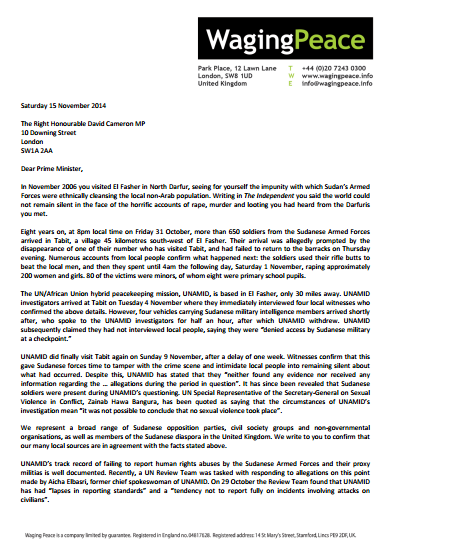
On Friday, October 31st the residents of Tabit were terrorized by government soldiers from the nearby military garrison south of El Fasher in Northern Darfur.

The solders first arrived in town on Friday morning. The commander falsely accused the citizens of kidnapping one of his soldiers and gave the town until evening to return him. The men and women of Tabit were not prepared for the night of horror which was to come.

The government soldiers returned at 8pm that night. They beat the civilians with the butts of their rifles and chased all of the men out of the village. The soldiers stayed until 4 am the next morning, raping approximately 200 women and girls. 80 of their victims were school girls, 105 of them were girls who were unmarried, while the rest were women who were married.

The men were only allowed back into the village after the soldiers had left, leaving behind dozens of wounded in desperate need of medical attention. The residents, however, have not yet been able to transfer their wounded to other towns or to medical centers. Therefore they are unable to leave Tabit, trapped without medical attention and surrounded by the worst night of their lives.

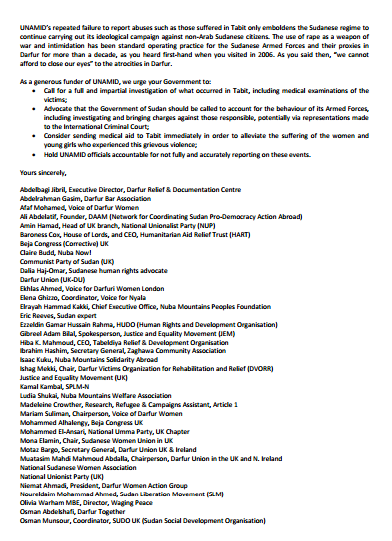
Darfur Womens Action Group condemns, in the strongest possible terms, the terrible criminal action of these soldiers and the government of Sudan who allows them to continue to rampage without regard for basic international human rights. We demand accountability for the perpetrators of these horrendous crimes.

We call upon the international community, the UN but also individual governments around the world. They must help the victims of Darfur, who have been suffering for the past 10 years, living in constant fear. The international community must also hold the Sudanese government, and the soldiers, accountable for their actions. The world can no longer look the other way while innocent lives are ruined forever.

This inhumane act against women demonstrates the fact that because of the impunity for previous crimes as well as the silence and inaction of the international community, these horrific crimes have continued. This is inhumane and intolerable. If world leaders are failing their responsibility to protect, then we the citizens must not remain silent.

We must unite our voices to denounce this cruel act of brutality and demand protection and justice for the women of Darfur.

The International Day for the Elimination of Violence Against Women : The Overlooked Plight of the People of Darfur

The International Day for the Elimination of Violence Against Women

The Overlooked Plight of the People of Darfur

The International Day for the Elimination of Violence Against Women was marked on November 25th. During the launch of this day, the United Nations held a conference during which UNESCO’s Goodwill Ambassador Forest Whitaker made a speech calling for the protection of women around the world and for stakeholders to end the violence against women.

( http://www.cctv-america.com/2014/11/15/actor-forest-whitaker-an-ambassador-of-peace )

Mr. Whitaker also spoke to the Youth Peace Network members, he urged them to seize the moment and speak out against the continuing violence against women. He paraphrased the UN by saying that violence against women and girls is the most widespread violation of human rights.

We at Darfur Women Action Group appreciate the UN and Mr. Whitaker’s statements concerning the world wide atrocities of violence against women. However we regret that in marking this important day the UN and UNESCO Goodwill Ambassador has largely ignored the horrendous acts in Tabit, where 200 girls and young women were raped in a single night, not to mention the situation for women in Darfur. This is very disappointing to us and to Darfuri and Sudanese women on the ground in Sudan. The UN cannot ignore such inhuman acts, it’s imperative that an event such as Tabit is remembered, brought to the world’s attention, and acknowledged on the International Day of Elimination of Violence Against Women to recognize the suffering of those who have been victimized by their own government.

On this occasion we stood in solidarity with the women in Darfur and the entirety of Sudan, by doing this we renewed our commitment to fight for the right of those who have been oppressed. We further renewed our call to our supporters to continue to promote our petitions until a concert action is taken by the UNto provide adequateprotect forwomen, men and children in Darfur. Our petition to the UN Security Council addresses not only the short term issues that arouse due to Tabit, but also long term issues. We have asked for an open investigation by UNAMID into what happened in Tabit and that the perpetrators of this horrendous crime be brought to justice. For the long term solutions we ask the UN to allow that humanitarian aid be allowed into every part of Sudan, and that UNAMID offer more protection to civilians.

We are pleased that the UN has recently issued a statement asking for a transparent investigation by UNAMID as well as full access to Tabit, unrestricted by government soldiers and the perpetrators brought to trial. This is precisely what our petition asked for concerning short term solutions. The UN however has yet to address the issue of long term solutions such as protection of the people of Darfur. (link to the UN statement concerning Tabit http://www.un.org/apps/news/story.asp?NewsID=49385#.VG0bgCjUaC1 ) Words must be matched with deeds and the deed that we want to see is that, investigation and accountability must be achieved. Unhindered humanitarian access and protection of the vulnerable must be prioritized by the UNSC and the UN peace keeping in Darfur.

We therefore ask the UN Security Council to effectively respond to our demands for long term solutions and continue to address the issue of Tabit and violence against women in Darfur at large. This heinous crime committed in Darfur is not one that can be forgotten, we cannot let the long suffering of women of Darfur, including the recent 200 girls and young women, go without justice. We urge our readers to join us in speaking up for women’s rights in Darfur and Sudan. Please sign our petition in order to make your voice heard, and to make a lasting change in Darfur and Sudan at large.

(petition https://www.change.org/p/un-security-council-protect-the-people-of-darfur?recruiter=25940690&utm_campaign=mailto_link&utm_medium=email&utm_source=share_petition )

List of Speakers for the Women & Genocide in the 21st Century Symposium

Fatou Bensouda

Fatou Bensouda joined the International Criminal Court as their Chief Prosecutor in 2011 after previously holding the position of the ICC’s Deputy Prosecutor since 2004. Before joining the ICC Ms. Bensouda had served the people of Gambia in many different legal capacities. Between 1987 and 2000 Ms. Bensouda served as Senior State Council, Principle State Council, Deputy Director of Public Prosecutions, Solicitor General and Legal Secretary of the Republic, and Attorney General and Minister of Justice. Ms. Bensouda then moved to the international stage serving as a delegate to the UN Conference on Crime Prevention, and as a delegate of Gambia to the Preparatory Commission for the International Criminal Court. She worked as a Legal Adviser and Trial Attorney at the International Criminal Tribunal for Rwanda. She then rose to prominence as Senior Legal Adviser and Head of Legal Advisory Unit from 2002 to 2004.

For FatouBensouda’s official International Criminal Court biography:

http://www.icc-cpi.int/en_menus/icc/structure%20of%20the%20court/office%20of%20the%20prosecutor/Pages/theprosecutor2012.aspx

Stephen J. Rapp

Stephen J. Rapp was appointed in 2009 as the Ambassador at-Large, heading the Global Office of Criminal Justice at the U.S. State Department. Before his appointment however, Mr. Rapp served as Prosecutor of the Special Court for Sierra Leone starting in 2007. Mr. Rapp was placed in charge of prosecutions such as Liberian President Charles Taylor and other persons suspected of committing atrocities during the civil war in Sierra Leone. During this time he became the first person to earn a conviction on the charge of recruitment and use of child soldiers, sexual slavery, and forced marriages under international humanitarian law.

From 2001 to 2007 Mr. Rapp served the United Nations as Senior Trial Attorney and Chief Prosecutor for the International Criminal Tribunal for Rwanda. He was appointedin 1997 as U.S. Attorney in Iowa, where he served two four year terms. Prior to his appointment Mr. Rapp worked as an attorney in a private practice and was elected to the Iowa Legislature.

For Stephen Rapp’s official biography:

http://www.state.gov/r/pa/ei/biog/129455.htm

Eric Reeves

Eric Reeves is a Professor at Smiths College who teaches a wide variety of courses, from Shakespeare to the History of Criticism, from Milton to the Technology of Reading and Writing. Professor Reeves has written about Sudan for the past 15 years and has become recognized as an expert in the study of Sudan and Darfur. He has studied Sudan’s culture, recent political crisis, as well as the humanitarian issues that have arisen as a result. On multiple occasions Professor Reeves has been consulted for advice concerning Sudan by humanitarian and human rights organizations. He has also been asked to testify in front of Congress several times. Professor Reeves has published two books concerning the Darfur conflict; in 2007 he published A Long Day’s Dying: Critical Moments in the Darfur Genocide, while in 2012 he completed Compromising with Evil: An Archival History of Greater Sudan, 2007-2012. Over the last couple of years Professor Reeves has been awarded multiple honorary degrees in recognition of his groundbreaking research.

For Professor Eric Reeves’ official biography:

http://www.smith.edu/english/faculty_reeves.php

Gregory Stanton

Gregory Stanton is the President, and Founder, of Genocide Watch, an organization dedicated to predicting, preventing, and punishing acts of genocide as well as other forms of mass murder committed anywhere throughout the world. Dr. Stanton is also a Research Professor in Genocide Studies and Prevention at the Institute for Conflict Analysis and Resolution of George Mason University.

From 2007-2009 Dr. Stanton was President of the International Association of Genocide Scholars, and in 1999 he was Chair of the International Campaign to End Genocide, the world’s first anti-genocide alliance.

Dr. Stanton served in the State Department (1992-1999), during this time he drafted the United Nations Security Council resolutions which resulted in the creation of the International Criminal Tribunal for Rwanda, the Burundi Commission of Inquiry, and the Central Africa Arms Flow Commission.

He served as a legal adviser to the RUKH, a Ukrainian independence movement, for which he was named the Ukrainian Congress Committee of America’s Man of the Year in 1992.

For Dr. Gregory Stanton’s official biography:

http://scar.gmu.edu/people/gregory-stanton

Ndimyake Mwakalyelye

Ndimyake Mwakalyelye is an anchor for Voice of America reporting for many different shows. The television show that she is most well-known for is called “In Focus”, which broadcasts in Africa, in this show Ms. Mwakalyelye reports on a multitude of issues.

Ms. Mwakalyelye has a very strong interest in Africa as well as other developing nations, and puts an emphasis on the struggles of individuals (especially women and children) in order to raise awareness of the crisis that have arisen.

Ms. Mwakalyelye was born in Tanzania and raised in Zimbabwe, she later moved to the United States to go to school and achieve a Bachelors degree from Howard University and a Masters degree from American University.

For NdimyakeMwakalyelye’s official biography:

http://speakerpedia.com/speakers/ndimyake-mwakalyelye

Niemat Ahmadi

Niemat Ahmadi is the Founder and President of the Darfur Women Action Group as well as the Director of Global Partners for United to End Genocide. Formerly, Ms. Ahmadi held a position with the Save Darfur Coalition, an organization which is driven to giving a voice to the Sudanese diaspora spread around the world. She is one of the founders of the Darfuri Leaders Network, a group of over twenty US –based organizations, all of whom worked together to help promote peace and security in Darfur. She also served as an adviser during the inter-Sudanese Darfur peace talks in 2006.

Ms. Ahmadi has a long history of helping the people of Sudan during her career working with NGOs. She has held positions with Oxfam Great Britain, Intermediate Technology Development Group, and the United Nation’s World Food Program. She was also an executive member of the Darfur Assessment Mission, a coalition of six Sudanese non-Governmental organizations who documented human rights abuses in Darfur during the crisis.

Ms. Ahmadi was born in Darfur; she was forced to leave, however, after two attempts on her life. She then moved to Kenya before traveling to the US where she has been helping give a voice to the people of Darfur.

For Niemat Ahmadi’s official Biography:

Niemat Ahmadi’s

Khalid Gerais

Khalid Gerais is a board member of Voices for Sudan, an organization which works to give a voice to the Sudanese diaspora community and help end the political crisis. Mr. Gerais is also the co-founder of Nubia Project, an organization which advocates for the protection of Nubian artifacts and culture against the flooding due to the building of dams by the government of Sudan.

Mr. Gerais has participated and attended prestigious events numerous times, at the US State Department, US Congress, and Hudson Institute. He has spoken at many colleges and universities on the topic of Kush Heritage in order to help bring more attention to the issue as well as educating the younger generation on a topic which is not widely discussed in the classroom.

For Khalid Gerais’ official biography:

http://www.zoominfo.com/p/Khalid-Gerais/1468253653

Honorable Thomas H. Andrews

Thomas H. Andrews is President and Chief Executive Officer of United to End Genocide. A former Congressman from Maine, Tom most recently served as National Director of Win Without War, a coalition of forty national organizations promoting a more progressive national security strategy that calls for prudent use of military engagement. He has worked to promote democracy and human rights throughout the world including Indonesia, Cambodia, Yemen, Algeria, Serbia, and Ukraine among many others. A long-time advocate of democracy and human rights in Burma, Tom has worked closely with the National Coalition Government of the Union of Burma, facilitated the creation of the European Burma Network and served as General Secretary of the Nobel Peace Laureate Campaign for Aung San Suu Kyi. Tom is a Senior Advisor to the National Democratic Institute for International Affairs, chaired by former U.S. Secretary of State Madeleine Albright. Tom was elected to the Maine House of Representatives in 1982, the Maine Senate in 1984 and the United States House of Representatives in 1990. Tom also served as president of New Economy Communications, a not-for-profit organization providing strategic planning and communication services to individuals and groups advancing labor and human rights issues.

Marion Arnaud

Marion Arnaud is the current representative for the office of the United Nations Secretary General on Genocide Prevention. She is a strong advocate for discussing conflict resolution and has participated in numerous End Genocide Action summitsas a panelist. Ms. Arnaud works with numerous ongoing conflicts and works to bring awareness to political and civilian issues at hand by working with the United Nations Press Release. Ms. Arnaud has a Master of Arts in Conflict, Security and Development from the University of Leeds, England and a Bachelor of Arts in Political Science from McGill University. Her work focused on the Responsibility to Protect in Darfur, which she began upon working at an internship in 2006. Ms. Arnaud has also worked on various educational and humanitarian projects ranging from France to Peru. She has also worked with providing briefings of the United Nations to the public as the officer for the Project Officer at the International Coalition for the Responsibility to Protect.

Ms. Arnaud has also participated in the 2000 Millenium Summit in which she worked on the reports on the status of crimes against humanity in North Korea and the responsibility for preventing war crimes.

Reverand Dr. Kemi Onanuga

Rev. Dr. Kemi Onanuga is the Founding President for the Pawla Organization and the Co-founder for the African Immigrant Caucus (AIC) as well as Ambassador for the United Nations. She also working on bringing advocacy to issues in Nigeria and working with Jesus House as well as MD State Coordinator for the campaign launched in response to the kidnappings of women and girls in Nigeria. Her work with Jesus House was to alleviating the damages of the violencein Nigeria and also in outreach efforts within the United States. She is an author and life-coach with her work as a role model well-known to young generation leaders. She also works as an administrative professional in Business Management and has a Doctorate in Theology. She is the Minister in Charge of the Pastoral Care Ministry at Jesus House DC and the Executive Director of the Redeemers’ Community Development Corporation.

Reverend Kimberly Barnes

Reverend Kimberly Barnes is the pastor Gethsemane African Methodist Episcopal Church in Landover, Maryland. She is co-pastor with her husband Reverend Ronald Braxton. This is her first pastorate position which she began in 2010. Before joining Gethsemane AME Church she was the assistant pastor of Metropolitan AME Church in Washington D.C.

Reverend Barnes also serves as the Executive Director and Founder of Voices for Hope. She has been volunteering in her community for many years, including volunteering at the Boys and Girls Club. When she was working as the assistant pastor for Metropolitan AME Church she became a co-facilitator of the Darfur Interfaith Network. While in this position Reverend Barnes organized many different protests including a protest on the Sudanese Embassy in Washington DC. Her activism lead to Reverend Barnes being nominated by the Washington Chapter of the American Jewish Committee to travel to Israel with a delegation of pastors and inspect the Palestinian Israeli Conflict.

For Reverend Kimberly Barnes official biography:

http://www.zoominfo.com/p/Kimberly-Barnes/1166954651

Jeffery Eide

Having spent a majority of his life living and working abroad, Jeffrey Eide became strongly intertwined with human rights and especially women’s rights in particular as a vehicle for progress in the world. The resistance to women’s progress cemented his passion. Now living the USA, Jeffrey heads the education and media outreach committee at the Fargo Rape and Abuse Crisis Center, where his current focus is The Redefining Masculinity Project, which aims to educate about attitudes and the role men play in preventing assault.

Professor Ahmed Adam

Professor Ahmed Adam is an internationally known Sudanese politician who is from Darfur. He gained his law degree from Sudan before moving to the UK to get a degree in public international law from Westminster University. Mr. Adam quickly became one of the most prominate voices for the people of Sudan on the international stage. He became one of the principle negotiators on behalf of the people of Darfur in peace talks sponsored by the United Nations, the Arab League and the African Union.

Professor Adam is currently working on a book called Darfur Betrayed: An Insiders Perspective which will analyze the peace process and the regional and international response to it as well as the Darfur crisis since 2004. From 2012 to 2014 Ahmed Adam was a visiting professor at Columbia University. For Professor Ahmed Adam’s official biography:

http://hrcolumbia.org/visiting/bios.php

El-Fadel Arabab

El-Fadel Arabab is a survivor of the Darfur genocide and has become an activist speaking at many events about Darfur and the importance of bringing President Bashir to justice.

When Mr. Arabab was only 12 years old the Janjaweed attacked his village. He managed to escape and get to Khartoum where he lived for years as a homeless child on the streets. He then found a relative in the city who managed to get him to Egypt where he stayed until 2004 when he traveled to the US.

Mr. Arabab is the secretary and lecturer of the Fur Cultural Revival Organization which is an organization committed to rising the governments awareness of the Darfur genocide, they also help serve the Darfur community in the Portland area.

For El-Fadel Arabab’s official biography:

http://endgenocide.org/el-fadel-arbab-arrest-omar-al-bashir-bring-justice-to-me-and-my-people/

Jo-Marie Burt

Jo-Marie Burt is a senior fellow at WOLA with her focus on Latin American Studies. She teaches political science at George Mason University and is acting as the co-director of the Center for Global Studies. Her research addresses political violence and state power, human rights and transitional justice, and social movements in Latin America.

She also directs a research project on the prosecution of perpetrators of grave human rights violations committed in Peru (special regards to its armed conflict) and in Latin America more broadly. For more information see the project website at http://rightsperu.net)

Zeinab Mohamed Blandia

Zeinab Mohamed Blandia is a Muslim peacemaker from Sudan and has been involved in creating community and maintaining peace in the Nuba Mountains which is one of the most conflict-affected and neglected regions of the world. She is the founder and director of Ruya, or “Vision,” which is an organization in Kadugli in the south and also in Omdurman in the north where Zeinab trains and cultivates fellow “women peace ambassadors.”She works in the Nuba Mountains to develop economic skills of women through teaching on subjects such as savings accounts. Her groups together identify conflict issues and work with peacebuilding at the level. She is also involved in the program “Women Bridging” which allows women to exchange vists within the state as well as trains illiterate women in solar engineering. She is working in training women in technology as well as conflict resolution methods in indigenous areas. For more information, go to: http://www.sandiego.edu/peacestudies/institutes/ipj/programs/women-peacemakers/about/zeinab-mohamed-blandia.php

Femme

Femme is a documentary depicting different voyages of women across the world who are involved in global society and the ways in which society can be healed from previous conflict. Women in this documentary discuss and lead in religious, scientific, historic, political, and entertainment issues that require advanced and multi-tiered solutions. The documentary seeks to highlight the work of women around the world in hopes of opening the door to conversation and women’s involvement in world issues. For more information, go to Femmethemovie.com

A Problem From Hell

Inspired by Samantha Power’s Pulitzer Prize-winning book A Problem From Hell, this multi-faceted documentary interweaves Raphael Lemkin’s struggle with the courageous efforts of four individuals keeping his legacy alive: Luis Moreno Ocampo, Chief Prosecutor of the ICC; Samantha Power, U.S. Ambassador to the United Nations; Ben Ferencz, a former Nuremberg prosecutor still tenaciously lobbying the UN for peace, and Rwandan Emmanuel Uwurukundo, UN Refugee Agency Field Director.

Elizabeth Bohart

Elizabeth Bohart is the Director for Outreach Strategy and the Executive Producer with Watchers of the Sky. She worked with strategic planning in Eastern Africa and also worked with an UK based consultancy on assisted private equity. She oversaw the development of the film and its educational outreach that targeted middle and high school curriculum. She is a strategist behind the development of the film’s program and community engagement. She is also on the board of directors of Maloto which is a nonprofit organization based on Malawi. Bohart also works with a violence-preventative organization that works to teach young people conflict resolution skills.

Amelia Green Dove

Amelia Green Dove is a producer, filmmaker, and journalist. She was a field producer for the filmmaker Michael Moore’s Academy Awared feature documentary and was an associate producer for Bill Moyer. She worked as a researcher for the BBC Open University division in London and has worked with Edet Beluberg on The Recruiter. She is also the film outreach Engagement Campaign Manager for Watchers of the Sky.

Omer Ismail

Omer Ismail was born in the Darfur region of Sudan and is the Senior Enough Advisor. For the past 20 years, Omer worked with international organizations on human rights and relief efforts. He founded the Sudan Democratic Forum and helped develop a think tank for Sudanese intellectuals who were assisting with the development of democracy in Sudan. He also founded the Darfur Peace and Development organization to spread awareness of the ongoing problems in Darfur and worked as policy adviser with agencies in crisis management. Ismail was also a fellow at Harvard University for the Kennedy School of Government.

Bama Athreya

Bama Athreya is the Senior Specialist for Labor and Employment Rights at USAID. She formerly was the Executive Director of United to End Genocide which is a collaboration with the Save Darfur Coalition and the Genocide Intervention New York. She has spent many years with her dedication to human rights, ending genocide, and preventing human rights atrocities. She worked in the 1990s to expose mass atrocities by Exxon Mobil in Aceh as well as lived in Cambodia during the United Nations Transitional Authority attempt to end the civil war. Athreya also is a member of the Council on Foreign Relations and of the National Committee on US- China Relations and holds a B.A. in Comparative Literature from the University of Pennsylvania. She also is an appointed member of the special Consultative Group on Forced and Child Labor and publishes on issues of child labor in countries abroad.

Norrie Kurtz

Norrie Kurtz was born in Brooklyn, NY in 1943 during World War II. Her family moved to a small resort town in upstate NY when she was 12. After receiving her Masters degree, Norrie worked as a speech pathologist in a school for neurologically impaired youngsters and subsequently as an audiologist for 20 years at Manhattan Eye, Ear & Throat Hospital in NYC.

Ambassador Mathilde Mukantabana

Mathilde Mukantabana presented her credentials as Rwanda’s ambassador to the United States on July 18, 2013. The Washington post is Mukantabana’s first diplomatic position of any kind. She is also non-resident ambassador to Mexico, Brazil, and Argentina.

She came to the United States in 1980 to attend Sacramento State University, where she earned an M.A. in history in 1986. She also married a professor, Alexandre Kimenyi, who taught linguistics, ethnic studies, French and African languages. He was a Rwandan activist whom she had known in Rwanda. Mukantabana went on to earn another master’s degree, this one in social work, with the hope that it might help her rebuild her country.

Mukantabana began teaching history at Cosumnes River College in Sacramento in 1994. That was also the year of the Rwandan Genocide, in which thousands of Tutsi were massacred by members of that country’s Hutu majority. The same week that she was hired by Cosumnes River, she learned that among those killed were both her parents, three sisters, two brothers, six aunts, four uncles and all of her nieces and nephews.

Ikhlas Mohammed

Ikhlas Mohammed is a Sudanese youth leader with United States Institute of Peace’s Middle East & Africa team, with with responsibility for conducting a research project in Women Role and Conflict Resolution in Darfur. From 2010 up 2013 she was working as a translator and interpreter with United Nations and African Union Mission in Darfur in Zalingei. Currently she is working with UNAMID/ Khartoum Office in Security Section since 2013; she also worked as Volunteer Teacher with Sudanese National Association for Blinds from 2007 up 2010. She was working as communication and coordination secretary in National Staff Association in UNAMID, and Published Nafaj Magazine that discusses the National Staff concerns in UNMAID and the sociocultural issues of the local citizens in Zalingei and the role of the mission in Zalingei.

Ikhlas has a bachelor degree in arts and humanities sciences department of English language from University of Juba, and she is a master degree holder in Gender and Migration studies from Ahfad University for Women in Sudan.

16 Days of Activism to End Violence Against Women

16 Days of Activism to End Violence Against Women

Today, the Darfur Women Action Group will be launching our 16 days of activism to bring awareness and action against violence directed to women in Darfur. Through November 25 to December the 10th, we will be sharing stories of suffering and resilience in order to provide opportunities for others to take action. While allowing for women to take part in representing their voices and facilitating dialogue between reader/writer, we will be actively sharing our UNSC petition as well as our petition to the Congress. Our petitions will call for immediate and collective action to be directed at the incident in Tabit as well as share ways in which readers can immediately partake in addressing human rights violations.

These 16 days of activism is also an opportunity to invest in the resiliency noted in the women of Darfur. We will launch a fund raising effort to build women empowerment center to provide support needed for the women in Tabit including Medical treatment, Psychosocial support and trauma counseling It is a practical response to the long standing violence against women in Darfur, and, as such, this project will provide women with a place needed for them to share, to develop their priorities and survival strategies, to seek counseling and solutions to rape and other multiple problems facing women in the camps daily. By coming together, the women’s strength can be realized through the absence of their regular isolation. In addition, telling their stories will help women turn their bitterness and fear into productive energy, enable them to speak up, overcome stigma, start to heal and be prepared to seek justice.

Readers will also have the chance to donate funds to help support these women to return to their lives and to continue speaking out on the violation of human rights. It is the goal of the Darfur Women Action Group to continue sharing these petitions as well as partake in demonstrating the subaltern female voice from Darfur to break the silence that is often given to women. With these stories, women will have the chance to themselves portray the picture and depict the problems with which grassroots organizations may utilize to restore dignity in their communities. it. Please join us in these 16 Days of Activism and take part in a unified stance against violence.

Join us and take action to end violence against women and to end genocide in Darfur -Sudan.

Here what you can do to help:

  • Sign our petition and share it with 10 people in your network
  • Donate to support our practical response to Tabit incident to help women overcome; link to our give page.
  • Tweet and share our action on FB; use our Hash tag #StopRapeInDarfurNow , #SpeakUp4WomenOfDarfur
  • Read our blog and share it widely
  • Send us your solidarity message that we can share with women of Tabit via tweeter or FB

Darfur Women Action Group Called for the UN General Assembly and the UNSC to match its Rhetoric with realities on the ground in

September 19

For contact: Niemat Ahmadi, President, Darfur Women Action Group , info@darfurwomenaction.org (804) 439 2022

Do not Forget Darfur!

Darfur Women Action Group Called for the UN General Assembly and the UNSC to match its Rhetoric with realities on the ground in Sudan

Darfur Women Action Group wishes to remind the United Nations Security Council, the Secretary General and the UN General Assembly in its call for collective responsibility to protect to not “Forget Darfur!”

UN Secretary-General Ban Ki-moon in his remarks to the General Assembly on August 8th has called for the need for collective responsibility to respond to the crises in the world and has included several countries, however, he has utterly failed to recognize the suffering of Sudanese people particularly in Darfur where genocide has been ongoing for more than a decade. (http://www.un.org/News/Press/docs/2014/sgsm16127.doc.htm).

As stated by DWAG president Niemat Ahmadi, “the ongoing genocide in Darfur and the multiple crises in Sudan are crises of a global magnitude that requires global response, failure by the UN or its Secretary General to recognize will simply mean its enabling. It is imperative that the collective effort for responsibility to protect be inclusive and Sudan should not be an exception.”

It has been 10 years since then US Secretary of State Colin Powell declared, “genocide has been committed in Darfur.” Ten years down the road—millions of men, women, children and the elderly in Darfur remain suffering from the systematic attacks and destruction of lives and livelihood throughout the greater Darfur region that has been ongoing since 2003.

President Omar Al-Bashir of Sudan stands accused by the International Criminal Court (ICC) for the world’s worst crimes – genocide, war crimes and crimes against humanity, committed in Darfur. Yet President Al-Bashir remains at large as an international fugitive of justice and still perpetrating the same crimes in Darfur and has extended his crimes to the Nuba Mountains and Blue Nile regions of Sudan with total impunity.

While the African Union-United Nations Mission in Darfur (UNAMID) to date has nearly 27,000 forces and civilian personnel, the mission is largely failing to protect civilians or adequately report incidents of attacks against civilians or the systematic violation of human rights and international humanitarian law by the Sudanese government and its allied militias of janjaweed.

UNAMID has not only failed to carry out its mandate but it has been criticized because of its partiality and lack of accuracy in reporting civilian causalities as has been recently disclosed by the former UNAMID spokesperson.

Despite of these failures, last August 31st, the UNAMID’s mission tenure has been renewed. Amidst these internal challenges and changes with new leadership in the UNAMID, sadly, continuous waves of violence, widespread hunger, displacement and disease including the influx of Hepatitis and prevalent malnutrition are the realities that the Darfuri people has had to contend with time and again. It is quite clear that UNAMID’s existence in Darfur is meaningless unless it’s mandate is given a stronger civilian protection component.

Recognizing these harsh realities on the ground, we at the Darfur Women Action Group, demand that the United Nations General assembly must match its rhetoric with realities on the ground in Sudan. The UN Security Council should fulfill its responsibility by providing protection to the suffering people of Darfur and Sudan at large.

We further demand that UNAMID must be granted a stronger civilian protection mandate, press the Sudanese government to immediately cease its attacks against civilians in Darfur, South Kordofan and the Blue Nile and to disarm the janjaweed. It is also a must to open an unhindered and non-negotiable humanitarian access to the needy throughout Darfur, South Kordofan and the Blue Nile regions of Sudan. President Al-Bashir and all perpetrators who committed and continued commit crimes against civilians in Darfur and other regions of Sudan, should be held accountable.

Furthermore, in honoring the commitment made at the 2005 World Summit enjoining the UN as a body and its member states to take initiative and have a collective responsibility to protect—the plight of the Darfuri people must not be forgotten.

The UN Secretary General also said in his August 8th address that “turning a blind eye is unacceptable”—let this serve as a challenge for us all to not turn a blind eye to this decade’s biggest silent genocide and give the Darfuri people the justice, protection and freedom that they so deserve.