Sudanese Government’s “Ceasefire” is Fundamentally Meaningless

Sudan Tribune reported last week that Sudanese President Al-Bashir has extended the government’s “unilateral ceasefire,” covering the Darfur region and various other areas of Sudan. This would be important news, if there was even a grain of truth to it.


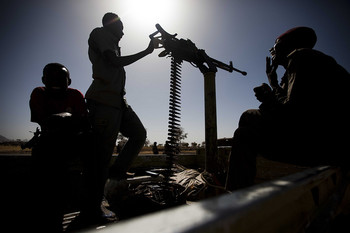
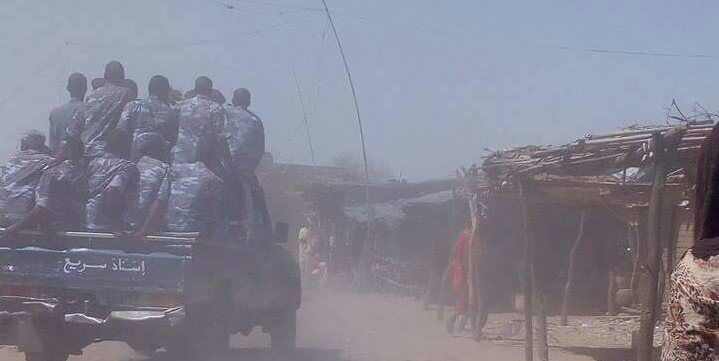
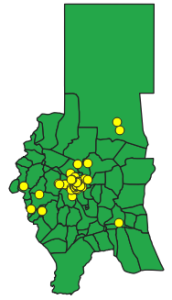
This “ceasefire” was declared in 2016, and has had no discernible impact on actual government military behavior as government forces continue to carry out attacks against civilians. This year alone, uniformed government forces – including RSF – fought pitched battles with Rebel groups on 55 occasions.[1] The bulk of these attacks occurred in the Jebel Marra region at the center of Darfur, long a rebel-controlled area, during a government campaign to penetrate the region and root out rebel positions. This offensive has destroyed civilian villages, killed women and children, and led to the displacement of between thirty and fifty thousand people.[2] A frequent phrase in Radio Dabanga reports throughout the past several months has been “government forces shelled ___ village.” Despite the positive press image as portrayed by Khartoum, the regime continues to launch offensive military campaigns against the indigenous groups in Darfur.
Government and Rebel Battles

Map: Battles between Government and Rebel Forces in 2018

The ceasefire, called “unilateral” throughout the media despite depending on an agreement between multiple parties, is only between the government of Sudan and several rebel groups. These include the Justice and Equality Movement (JEM), Sudan Liberation Movement- Minni Minnawi (SLM-MM) and SLM- Transitional Council (SLM-TC), the last of which is defunct and currently controls neither military forces nor territory. The Government of Sudan therefore does not have an agreement with the remaining SLM-AW, led by Abdel-Wahid al-Nur. The fact that only a single rebel group remains fighting against the government does not mean a decrease in violence. In fact, there have been 190% more recorded firefights between government and rebel forces in the first seven months of this year compared to the total number of attacks in the entirety of 2017. It must be made clear where lies the responsibility for this escalation of violence: government policy. Rebel groups have made no attempt to break out from their base in Jebel Marra. Rather, government forces converged on the region in spring of this year, and renewed their assault on rebel positions, firing rockets and artillery indiscriminately into villages.
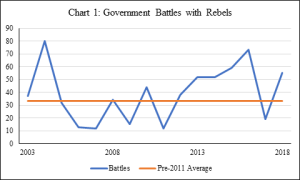
 

image (4)


Not only do government forces continue to assault rebel positions, they also continue to perpetrate mass violence against the civilians of Darfur, again despite government claims to the international community about a “ceasefire.” Independent observers recorded 68 incidents of violence against civilians perpetrated by uniformed government forces so far in 2018.[3] Like the fighting between government and rebel forces, government attacks on civilians increased dramatically in 2011 following a renewed government offensive in Darfur, which is still ongoing. The level of violence against civilians in Darfur in 2018 is again above the average level during the pre-2011 period. This fact is fundamentally inconsistent with the notion that peace has been achieved in Darfur, and fundamentally inconsistent with the notion that a “ceasefire” has really been placed into effect. Certain weak rebel groups may have temporarily stopped fighting, but that does not mean government firing has ceased in Darfur.
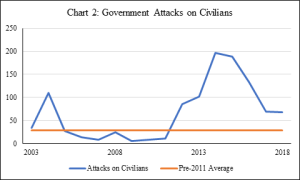
 

image (5)


All of the above analysis demonstrates that the current level of fighting in Darfur today is actually historically high. The government launched a major offensive in Darfur in 2011, and violence continues at a level above the average before this offensive. What we see is clear indication of an ongoing, indeed escalating, government offensive in Darfur. This is not a ceasefire.


Because the wording of United States Executive Order 13067[4] specifically mentions a decline in “offensive military activity” on the part of the government of Sudan, because this then became a key metric of the “Five Track”[5] approach of the United States towards Sudan, and to create talking points for supporters of the Khartoum regime throughout the international community, it is important for Bashir to publicly commit to peace. It is desperately important to understand that this lip service has absolutely no substance. Bashir is not committed to peace, and any “ceasefire” proclaimed by the government is meaningless until the government actually decides to cease firing their weapons, especially when these weapons are often directed against civilians.


The United States is obligated by its own five-track policy to undertake practical step to assess the situation on the ground in Darfur. The United States cannot take the rhetoric of Khartoum at face value, nor can it be allowed to promote its own rhetoric of sustained peace in Darfur without any verification, especially when the facts on the ground so clearly indicate that peace has not been achieved. The Government of Sudan is desperate for international engagement and normalization of relations with the United States. They must not be allowed to achieve these goals without actually committing to peace in Darfur.


Peace in Darfur will not be achieved through rhetorical declarations, but rather through realistic measures to monitor and ensure it. DWAG believes that only the disarmament of the government’s notorious Rapid Support Forces and other Janjaweed militias, realistic accountability for the crimes committed by government officials, and a genuine peace process can put an end to the crises in Darfur.

[1] ACLED

[2] Radio Dabanga reports 50,000. The Prosecutor for the International Criminal Court reported 30,000 in her appearance before the UN Security Council in June.

[3] ACLED

[4] Signed by President Obama in January of 2016, this order began the process by which President Trump removed economic sanctions against Sudan in November of 2017.
High Level Polish-Sudan Diplomacy is an Affront to Justice

Sudan Tribune reported earlier this week that the foreign ministers of Poland and Sudan met in Khartoum on July 21st, to discuss a number of issues of common concern to both countries. Following their meeting, Polish Foreign Minister Jacek Czaputowicz made a statement regarding Poland desire for closer relations with Sudan. This is an incredibly worrying development.

Poland has historically been a strong advocate for the people of Darfur, who have long suffered from government violence and genocide. This was true a month ago, when the Polish delegation to the United Nations made a very strong statement at the UN Security Council meeting on June 20th, 2018. Poland noted concern for an uptick in violence in Jebel Marra, stressed that return of IDPs to their homes must be truly safe and voluntarily, demanded protection for women and girls from sexual violence, and called for any reduction of UNAMID personnel to be compensated for with an increase in UN country team presence. Additionally, Poland stressed full support for the Prosecutor of the International Criminal Court in her investigation into crimes committed in Darfur and the need to hold the powerful accountable for their actions. This is all incredibly powerful speech.

However, actions speak louder than words. The Sudanese government is on the ropes, as it faces the possibility of the outbreak of famine and severe domestic unrest among its traditional power base. Khartoum is desperate for international legitimacy and access to international markets. This could be a turning point in Sudanese politics, but if Poland and other states like it – especially those states bound by the Rome Statute – give the Khartoum regime life support at this critical time, the consequences for the people of Darfur will be dire. Poland must not extend economic ties to Sudan, and must live up to its own words at the United Nations and hold President al-Bashir and his government accountable for their many crimes.

That Poland continue to demand justice for the people of Darfur and accountability for the leaders of the Sudanese government is especially important given Poland’s position within the international community. Poland is a state signatory of the 2002 Rome Statute, which established the International Criminal Court. This Court filed arrest warrants against Sudanese President Omar al-Bashir in 2009 and 2010, for crimes against humanity, war crimes, and the crime of genocide. Poland is also currently serving a term as a member of the United Nations Security Council. Poland must use this position of great power to protect the vulnerable people of Darfur, and demand justice for the atrocities committed by the current Sudanese government.

More worrying than just that the Polish Foreign Minister chose to visit Sudan, is who he chose to meet while there. Sudan Tribune reported that Minister Czaputowicz met with Sudanese Prime Minister Bakri Hassan Saleh, who was Minister of Defense from 2000 to 2005, the period of the start of the genocide in Darfur. After participating in the 1989 coup which brought President al-Bashir to power, Saleh held other important positions within the Sudanese government including head of the National Security Service and Minister of the Interior, and he has been rumored to be a possible successor to al-Bashir. In a regime tainted by genocide to its very core, a man this powerful has blood on his hands. That Poland would grant this man legitimacy in the form of a one-on-one meeting with its Foreign Minister is deeply disturbing, and completely violates any notion that Poland truly seeks to hold this regime accountable.

Unfortunately, this meeting follows a dangerous trend in the international response to Sudan. The United States removed economic sanctions against Sudan in November of 2017, despite clear evidence that Sudan had not actually met the qualifications for sanction removal. Similarly, the European Union signed a deal with Sudan regarding illegal migration in 2015.

The responsible states of the world have an obligation not to support the current Sudanese regime. But not only should these states not deal with the Khartoum government in the first place, they should also recognize that this same government has been dealing in bad faith since its very inception, and that this pattern has not changed in recent years.

While Khartoum pays lip service to containing illegal migration (and the European Union pays cash for this lip service), officials as high up in government as President al-Bashir’s very own brother have been making money hand over foot operating the very human smuggling rings which the Sudanese government claims to be containing. Following an in-depth investigation, Refugees Deeply reported that the President’s brother has been operating a service selling Sudanese passports to wealthy Syrians. These Syrians can then fly to Europe as Sudanese citizens, destroy their Sudanese passports, and apply for asylum as Syrian citizens. Refugees Deeply also reported that Sudanese police, all the way up to high-ranking generals in the Armed Forces, are inextricably linked with the human smuggling routes from East Africa through Sudan into Egypt and Libya. You can read our summary of these investigations here. When Sudan does in fact stop migrants from crossing the borders of Sudan, they employ the brutal Rapid Support Forces, formed from the infamous Janjaweed of the early 2000s, and responsible for mass atrocities throughout Darfur.

The Sudanese regime is equally hypocritical in regard to “conflict resolution,”. The government constantly references their “unilateral ceasefire” in Darfur, however this agreement is neither unilateral nor a ceasefire. A select group of rebel forces, weakened by combat to the point that they no longer control fighting men or territory, have agreed with the government of Sudan to stop fighting. However, the government of Sudan continues to pursue an aggressive offensive against the remaining rebel group, Sudan Liberation Movement/Army – Abdul Wahed (SLM/A-AW). The recent government campaign in the Jebel Marra region, attacking rebel positions in a territory controlled by this group for years, has led to a marked uptick in civilian casualties as well as the displacement of between thirty and fifty thousand people. Despite a lack of media coverage, and despite the claims made by Khartoum propagandists, the government war against the people of Darfur continues unabated.

The Polish Foreign Ministry released a tweet relating to this meeting, stressing concern for human rights and cooperation with international organizations on the part of the government of Sudan. We certainly hope that the Polish government uses this opportunity to press Sudan to be sincere about its professed desire to see peace in Darfur, and for genuine compliance with international norms, laws, and organizations by the Sudanese government. However, it seems that the Polish government is more interested in pursuing economic ties with Sudan than actually holding this regime accountable for any of the promises it makes on these non-economic fronts. The two ministers discussed a Polish-Sudanese economic forum to be held, as well as ways to cement ties between the two nations’ agrobusiness industries and improve trade between them. This follows a similar meeting last year in August on this same topic.

Poland, with its own history of liberation from authoritarian oppression and atrocity, can be a leader of the international community. We urge that Poland continue to advocate for the people of Darfur long oppressed and victimized by their government in Khartoum, and truly back up Polish words with strong actions.

A Teach Tortured in Darfur for Speaking Out Against Government Abuse

The Sudanese Government has detained a prominent human rights advocate from Darfur. Matar Younis, a teacher, and Islamic religious leader is facing the death penalty or potentially life in prison because he courageously asking the Sudanese Government to change its policies in Darfur. Younis has been consistently harassed and harmed at the hands of President Omar al-Bashir’s regime for speaking out in defense of the rights of Darfuris.

Amnesty International, a non-governmental organization that advocates for human rights worldwide, has covered Younis’ case, bringing it to the forefront. Younis was violently assaulted by Sudanese security forces in February 2018, detained in April and has since been relocated to from Darfur to the capital of Sudan, Khartoum.

Younis has been charged with “waging war against the state”, “undermining the constitutional system” and even espionage, according to Amnesty. Tragically, the report reveals that Younis is visually impaired. It is hard to image the nightmare that this human rights activist is currently enduring.

According to press releases, the State Security Prosecution has postponed Younis’ trial, which was planned for earlier this month. As of right now, there is no date set for this trial, leaving Younis to remain in prison for an indefinite amount of time. While in prison, Younis is without any resources or access to assistance. Amnesty has also noted that Younis has been denied access to legal representation and is not able to see his family members.


Amnesty International’s Deputy Director for East Africa has described Younis as one of the “few voices” championing human rights in Darfur. He spoke of Younis’ fearless actions and has asked the Sudanese Government to “change its harmful policies and protect the displaced people of Darfur. He should not be criminalized for stand up for human rights.”

Younis was arrested along with Ahmed Haroun, a Darfuri shop owner who was also sent to Khartoum in December 2017.

The human rights of Darfuris have been consistently under attack for years. The Government of Sudan must be held accountable by the international community, including the United States Government for its continued abuse and denial for basic human rights and freedoms.

For years human rights in Darfur has been under attack. The government of Sudan must be held accountable by the entire International Community, including the United States government, for its continued abuse and denial of basic human rights and freedoms.

DWAG Response to Darfur Highway Construction

On July 11, 2018, Radio Dabanga reported: “Sudan’s National Roads and Bridges Corporation and El Juneid Company have signed a contract for the construction of the Nierteti-Rokoro-Tarny-Tabit road in Darfur, with a length of 90 km, to be implemented within a period not exceeding 30 months.”

DWAG certainly recognizes the need for infrastructure improvements in Darfur. However, when the overwhelming majority of Darfuris are in displacement camps and still fighting for bare survival, priority must be given to security and well-being of the people if the government is sincere in its stated desire to bring peace and development to Darfur. Observers of Sudan and Darfur should not lose sight of the real issue, and we must see this government ploy for what it really is: an attempt by the government to distract from its genocidal military campaign in Darfur and seize some international good press.

The al-Bashir regime has gone to great lengths to promote the notion that genocide in Darfur is over, and that Darfur is now a post-conflict zone in need of development. This is a fabrication and a smoke-screen. ACLED reports that there have been 215 violent incidents in Darfur in the first six months of this year alone. Uniformed government forces and militias continue to ravage the population of Darfur, including during a recent and ongoing military campaign in the Jebel Marra region which has displaced over 30,000 civilians.

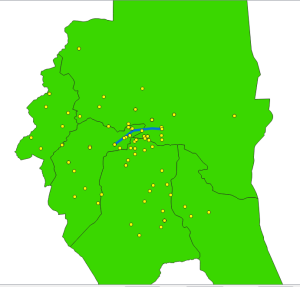
The map below shows the route of the planned highway in blue, and the sites of all recorded incidents of violence against civilians perpetrated by government forces and militias, reported by ACLED within the first six months of 2018. The proposed highway cuts straight through the Jebel Marra region, which can be clearly seen as the center of the largest cluster of incidents of violence against civilians. The international PR campaign intentions are clear: the government of Sudan wants to be seen as helping the people of Jebel Marra. If the government really wanted to help, it would end the campaign of violence against civilians which is currently ongoing.

Proposed Highway

Map 1: Proposed Highway and Violence Against Civilians in 2018


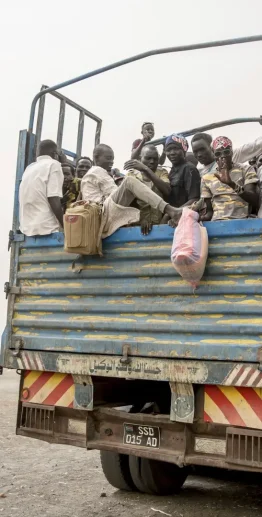
The announcement of this highway project comes at the same time as Bashir’s continued attempts to close IDP camps throughout Darfur and to bring Darfuri refugees back to Sudan from Chad. Again, we must not attribute the motivations for these projects as the Sudanese government sign of change of heart but as part of a tactic the regime has long used to divert attention from the long suffering of the people of Darfur. This is a show for the international community, as the Sudanese regime desperately needs legitimacy in order to rescind decades-old sanctions which have crippled the Sudanese economy. Bashir has a long history of willingness to talk the talk. He has never been willing to walk the walk of real peace and prosperity for the people of Darfur, and this road is no exception.

Sudan’s Migration Hypocrisy

The al-Bashir regime benefits from better relations with the West after signing deal to stop migration through Sudan into Europe. Yet the President’s own brother is intimately involved in running those very migration routes.

The Government of Sudan announced earlier this week its intention to develop a “national anti-human trafficking” strategy.[1] This is part of a recent pattern whereby Sudan has improved relations with the West by agreeing to stem the flow of migrants from the continent of Africa into the European Union. It also fits a much longer pattern of Sudan making promises to the international community, receiving the benefits of this nominal cooperation, and refusing to actually change its ways.[2]

What’s worse, these deals legitimize the very organs of the Sudanese state most deeply involved in the crimes of the past 20 years. These crimes include war crimes, crimes against humanity, and genocide, as determined in 2009 by the International Criminal Court, which issued an arrest warrant on these counts against Sudanese President Omar al-Bashir that year.

The group most intimately involved with stemming migrant flows through Sudan is a government-run paramilitary organization called the Rapid Support Forces. This group has its origins in the infamous Janjaweed militias, internationally known for brutalizing the people of Darfur in the early 2000s. The change of name did not bring a change of behavior, and the RSF is still responsible for the bulk of violence against civilians during the recent – and ongoing – government assault on the Jebel Marra region of Darfur during the spring and summer of this year.

Despite this legacy of violence, RSF involvement in migration deals between Sudan and the European Union have emboldened the commander of the RSF to demand international recognition, and to attack the EU for not “thanking” his murderous organization.[3] The trend in Sudanese-EU relations towards normalization suggest that such thanks may not be long in coming. This would be extremely misguided, and a deep disregard of international norms.

Even if Sudan were actually serious about working with the European Union in the field of migration, a soft European policy on Sudan disregards the lives of millions of Darfuri’s and other Sudanese who have been systematically victimized by the al-Bashir regime. However, even the recent warming of EU-Sudanese relations itself is based on lies and fundamental criminality on the part of the Sudanese regime. Indeed, in-depth reports by Refugees Deeply (RD), an “independent digital media project dedicated to covering refugee and migration issues around the globe,” uncovered evidence that Sudanese officials have been aiding illicit migration, including working with human traffickers, all throughout the period of EU-Sudanese deals. RD has reported on the multiple forms that this cooperation takes, detailed below.

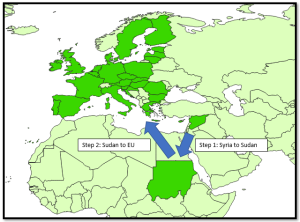
The RD reports note that the government of Sudan is intimately involved in funneling migrants through Sudan into Europe, which high-level officials running the show every step of the way. Most recently, RD reported that President al-Bashir’s younger brother is operating as the head of a project to bring migrants through Sudan from Syria into Europe. This hypocrisy is typical of the al-Bashir regime. As with repeated bad faith “deals” with rebel groups in Darfur, and “ceasefires” which don’t keep government forces from shooting, the government of Sudan is willing to sign agreements, just not honor them. Al-Bashir will likely continue to gain better relations with the West, all while personally enriching himself and his family running the very migration flows he is being paid by the European Union to stop.

The mechanics of these routes, and government involvement, is detailed below:

1) Selling Sudanese citizenship to wealthy Syrians.[4]

Sudan Migration Pathway 1

Refugees Deeply (RD) reported in January of this year that Abdullah al-Bashir, the brother of Sudanese President Omar al-Bashir, is personally involved with the sale of Sudanese citizenship for profit. Syrians would pay upwards of $10,000 for a Sudanese passport, issued by the state after delivery of payment to officials linked to al-Bashir. With this passport these newly minted Sudanese citizens could fly to the European Union, where they would destroy the Sudanese passports and apply for asylum as Syrian nationals fleeing the violence. The Sudanese government is not merely complicit in this process, but actively manages it, issuing real passports to paying customers.

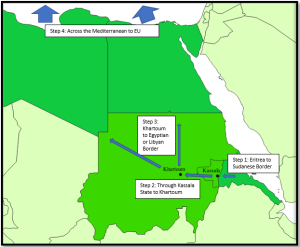
2) Cooperation with Human Smuggling Rings from East Africa[1]

Sudan Migration Pathway 2

A separate RD report followed the path of an Eritrean migrant through Sudan, eventually to Egypt and beyond. Groups of migrants were collected at various points in Eritrea before being moved across the border to the Sudanese city of Kassala, thence through Kassala state to Khartoum. Kassala state is notorious as a hotbed of criminal smuggling activity, where the smuggling economy is inextricably linked to connections with government officials. The map above charts the path described by RD. Government officials are complicit in the transport of migrants through every step of the process detailed above, except for the final transit of migrants across the Mediterranean.

This is precisely the type of migration that the new “strategy” is nominally designed to stop. However, that Sudan has acknowledged the existence of trans-Sudan migration does not mean that the government actually has any real intention of stopping it. This is yet another face-saving pronouncement designed to create the appearance of cooperation with the European Union, without any real policy changes.

The networks transporting migrants from East Africa through Sudan are not mere criminal organizations but are in deep cooperation with government officials. Indeed, one source who has been employed at various times as both a smuggler and a police officer, noted that it was impossible for smugglers to operate without the knowledge and consent of local police. The Eritrean migrant whose path was highlight by RD remarked that he was transported from the Eritrean border to Khartoum in vehicles identical to those used by Sudanese police, and was not stopped once at any of the police checkpoints along the route. This is in contrast to his initial attempt to get to Khartoum by bus, where he was stopped by police officers due to lack of sufficient funds to pay their bribes.

Importantly, the routes from Khartoum to Egypt and Libya operate not only with the cooperation of government officials but are explicitly run by veteran high-ranking soldiers of the Sudanese Army, and are publicly advertised in open air markets within Khartoum. Much like the sale of Sudanese passports to high-paying Syrians, this is big business run by big officials. If the government of Sudan were serious about stemming migration, they would shut down these openly marketed businesses operating right under their nose in the capital city. Alternately, President al-Bashir could force his own brother to stop operating a Syrian migration racket. Instead, the President employs the murderous RSF to terrorize occasional parties of migrants en-route to the Libyan border, gaining recognition and funds from the European Union all along the way.

[1] https://www.newsdeeply.com/refugees/articles/2018/01/19/sudan-the-e-u-s-partner-in-migration-crime

[1] https://reliefweb.int/report/sudan/sudan-develop-national-anti-human-trafficking-strategy

[2] https://www.irinnews.org/special-report/2018/01/30/inside-eu-s-flawed-200-million-migration-deal-sudan

[3] https://www.dabangasudan.org/en/all-news/article/commander-of-sudan-s-main-militia-wants-international-recognition

[4] https://www.newsdeeply.com/refugees/articles/2018/02/01/passports-for-sale-how-sudan-profits-from-syrians

DWAG Statement on UNSC Vote Regarding Renewal of UNAMID Mandate

The United Nations security council is set to vote on renewing the mandate of the United Nations – African Union Hybrid Mission in Darfur tomorrow, on July 12th. UNAMID has served in Darfur since it was founded in July of 2007. Most recently, UNAMID’s mandate was extended for two weeks at the UN Security Council on June 30.

The international community must not abandon the people of Darfur, especially not now. The notion that conflict in Darfur, and especially the targeting of civilians by government forces and government-aligned armed groups, has ended is patently false. The Armed Conflict Location and Event Data Project has recorded, 215 violent incidents in Darfur in the first six-months of 2018 alone. Violence has heated up this year, especially during a government military campaign in the Jebel Marra region in the center of Darfur. Fatou Bensouda, the Prosecutor for the ICC, noted that this government campaign has created about 30,000 newly internally displaced persons. Other sources hold this to be a low estimate. This is not the legacy of crimes a decade ago, but a political and security reality faced by the people of Darfur today.

Sudanese President Omar al-Bashir was indicted by the International Criminal Court in 2009, after the case if Darfur was referred to this body in 2005. Bashir is still at large, entirely avoiding being held to account for his crimes of that past 15 years. Tomorrow, July 12th, is the eighth anniversary of the second arrest warrant issued against Bashir by the ICC in 2010. It would be the height of irony if the international community formally abandoned its protection of the Darfuri people through UNAMID on the very anniversary of the day its own legal organ officially declared the conflict genocide.

DWAG Statement on UNSC Vote Regarding Renewal of UNAMID Mandate

DWAG Statement Condemning Turkey For Hosting President al-Bashir

On Monday this week, Sudan Tribune reported that Sudanese President Omar al-Bashir attended the inauguration ceremony of Turkish President Recep Tayyip Erdogan.

Bashir was indicted in 2009 by the International Criminal Court for crimes against humanity, war crimes, and genocide, for his government’s actions and policies in the Darfur region of Sudan. This genocide is still ongoing. You can read about the scale of the current genocide (here) and (here), as well as the most recent report by the ICC (here). Though only legally held to account in 2009, Bashir’s genocide in Darfur has been ongoing for 15 years, since 2003.

Turkey is not party to the Rome Statute, the founding document of the ICC, and is thus not legally bound to arrest Bashir and turn him over to ICC authorities. Turkey is, however, a member of the United Nations and the UNSC -R 1595 obligates all UN members to support the implementation of UNSC resolutions without exception. and it is morally imperative for Turkey not to host a genocidal dictator responsible for the death and displacement of millions of innocent civilians of his own country.

Turkey allowing Bashir to travel freely across its borders is not only an insult to victims of Bashir in Sudan, it is also an affront to international justice given the timing of the visit, coming as it did only three days before the eighth anniversary of Bashir’s second indictment by the ICC for the crime of genocide on July 12, 2010.

DWAG therefore wishes to remind Turkey, an important player in the region, that it is imperative to stand for justice and not against it. We further condemn Turkey for allowing Bashir to travel freely, and for refusing to hold him to account for his crimes against the people of Darfur.

DWAG Statement on Bashir Visit to Turkey

Statement on the 27th ICC Prosecutors Report Regarding Darfur to the UN Security Council, and UNSC Members’ Responses

On Wednesday, June 20th, Prosecutor for the International Criminal Court Fatou Bensouda briefed the United Nations Security Council regarding the progress of the ICC investigation of Darfur, pursuant to UNSCR 1593. She began her testimony with an admonishment of the international community that the people of Darfur have suffered so long and received so little justice. Noting that 13 years have passed since the case was referred to the ICC by the Security Council, Benouda remarked that all those indicted are still at large, and that conflict is still ongoing. The Prosecutor’s report also noted the recent fighting in Jebel Marra and acknowledged that 80,000 civilians have been displaced in recent months.

Specifically, Bensouda noted the lack of cooperation from the state parties to the Rome Statute in executing the arrest warrants against the perpetrators of genocide in Darfur. Sudanese President al-Bashir was indicted by the ICC in 2009, yet in 2018 alone has visited Jordan, Chad, Uganda, Ethiopia, Turkey, Egypt, Rwanda, and Saudi Arabia without arrest. Jordan, Chad, and Uganda are all three party to the Rome Statute and are therefore failing to uphold their legal obligation to the International Criminal Court.[1]

Several of the state delegates to the Security Council reinforced Madam Bensouda’s concerns and reminded the Council that the violence in Darfur is still ongoing. Madam Bensouda’s report noted particular concern with the safety of Internally Displaced Persons, that sexual violence is common around IDP camps, and that previously displaced persons are often targeted with sexual violence upon returning home. This is particularly concerning given President al-Bashir’s stated policy of closing the IDP camps in Darfur by the end of this year.

Following the Prosecutors address of the council, the state delegates of Council members made statements of their own in response.[2] Several of these responses were strong denunciations of the violence in Darfur and the Government of Sudan which commits it, as well as castigations of the Government of Sudan for its repeated refusal to cooperate with the ICC, UNAMID, and humanitarian organizations which attempt to operate in Darfur to provide services to the affected communities. These states noted especially the ongoing sexual violence prevalent in Darfur, especially carried out by Government forces, the rising level of arbitrary arrests throughout Sudan, and the importance of protecting IDPs. Among those speaking on behalf of the long-suffering people of Darfur were the delegates for the United Kingdom, France, the United States, Peru, Sweden, Bolivia, Poland, and the Netherlands. The United States strong statement regarding Sudanese accountability was noteworthy, and hopefully a harbinger of more responsible American policy towards Sudan, given the Trump administration’s removal of sanctions against Sudan in October 2017.

Several nations’ delegates instead replied to the Prosecutor’s briefing with hostility, lies, accusations, and coldly inhumane illogic. The delegates representing Ethiopia, China, Equatorial Guinea, Kazakhstan, Côte d’Ivoire, and Russia actually praised the Government of Sudan for it’s supposed efforts to achieve peace in Darfur. Such positions are of no surprise considering the human rights records of these governments themselves. The fundamental illogic of praising a genocidal regime for working towards peace was apparently lost on their delegates. These six states, as well as Kuwait and Equatorial Guinea, challenged the ICC jurisdiction and its right to indict a sitting head of state, attempting to discredit a powerful tool of the international justice, used by the international community in response to genocide.

The delegate from Sudan addressed the Council as well, repeating the same spin-doctoring and denials of fact which Sudan has published for years. He claimed that Sudan is a positive force in international relations throughout its geographic region, accused the prosecutor of a secret conspiracy against Sudan, denied that the international community had any right to prosecutor a sitting head of state, and that Sudan was being targeted as part of an international conspiracy against the legitimacy of African rulers. He failed to acknowledge that his government has perpetrated genocide against its own citizens.

To different degrees, many delegates acknowledged statements of fact regarding the level of conflict in Darfur which were at best misleading, and at worst patently false. First, several delegates applauded the government of Sudan for its role in diminishing the level of military conflict in Darfur. This presupposes two claims, (1) military conflict is declining in Darfur, and (2) the government of Sudan is playing a constructive role in making this be so. Second, multiple delegates again applauded the government of Sudan for improving humanitarian conditions on the ground in Sudan. We refute both claims based on available evidence of the reality on the ground in Darfur. This evidence is presented below.

 Claim: Violent conflict is declining in Darfur, and this is tied to government progress.

Fact: This year continues a recent trend of escalated violence as compared to historical averages, and the government of Sudan is in fact conducting significantly more military activity this year than it historically has.

image (3)

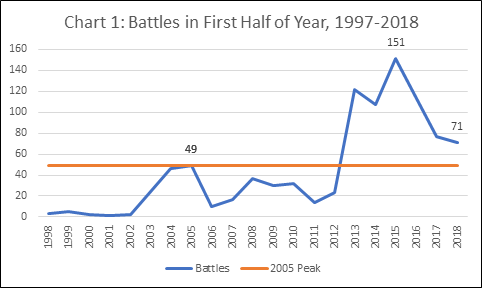
Chart 1 presents data collected by ACLED[3] on armed confrontations by this time each year, over the length of the conflict in Darfur. When put in historical perspective, claims by UN delegates that military violence in Darfur is diminishing are clearly dramatically optimistic understatements of actual conditions. Yes, the 71 battles thus far in 2017 reflect a slight decline from the 77 battles by this time last year. And yes, this is again a decline from the peak of 151 battles by this time in 2016. But in historical context, these numbers still represent an extreme escalation of violence in Darfur in recent years. The peak of 151 battles in 2016 was a massive 200% rise from the previous peak of violence in 2005. The 71 battles thus far in 2018 still represent a 45% rise in violence over the previous peak in 2005.

image (2)

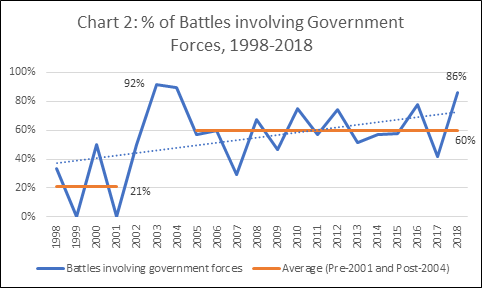
Not only is the general level of military activity unusually high, but the government share of that activity in 2018 actually represents an increase over recent averages. Chart 2 presents the percentage of all battles in Darfur which involved government forces.[4] Following a massive spike in government military action in 2002 and 2003, government involvement in battles in Darfur hovered around a relatively stable average of 60% since 2004. This year represents a statistically unusual high level of government military action, approaching the peak year of 2003. The government of Sudan has been involved in 86% of all battles thus far in 2018, which is greater than 1.5 standard deviations above the average for this time of the year since 2004.

Claim: The humanitarian situation is improving in Darfur.

Fact: This year continued to reflect a generally diminished security environment for civilians in Darfur, as compared to historical averages over the length of the conflict.

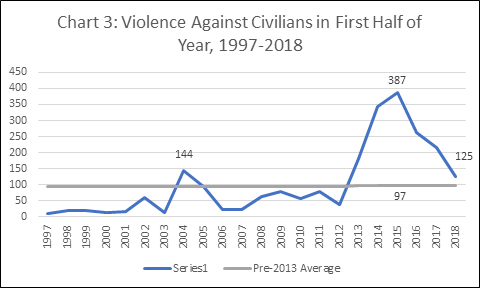
image (1)


Several delegates made the claim that the humanitarian situation on the ground in Darfur is improving. This is an utter contradiction from the available data, so extreme as to constitute an outright lie. This year has indeed seen a decline in incidents of violence against civilians when compared to this time last year. However, much like the level of military action described above, this reflects a decline within the context of extremely high recent levels of violence. The 125 recorded incidents of violence against civilians thus far in 2018 is 29% above the pre-2013 average, and within 13% of the pre-2013 peak of 144 incidents in the first six months of 2004. To put this another way, if the same level of violence against civilians in 2018 occurred in 2013, it would be an unambiguous escalation of violence. It only seems like a decrease, and can be disingenuously presented as such, because it follows the 300% spike in violence against civilians which occurred between 2013 and 2015, as compared to the previous historical average. To claim that the humanitarian situation in Darfur is “improving” because the level of violence against civilians is returning to the unacceptably high pre-2013 level is a fundamentally malevolent distortion of reality.

The UN delegates are cherry-picking historical trends, representing a decline from a massive local maximum as a general decline in violence, even though this still represents a time of heightened violence over the historical peak.

While it is important to highlight actual conditions in Darfur, and especially to point out where such powerful policymakers such as delegates to the UNSC misstate fact, such nitpicking about numbers is actually beyond the point. What is universally acknowledged is that, at whatever level, the Government of Sudan is committed to war against its own civilians. The question is not truly the amount of violence, or the numbers of battles, per year but whether the government of Sudan can be allowed to commit one single act of state violence against its own people in the first place.

In addition to what was explicitly discussed during the briefing, several trends were not mentioned by remain crucial to understanding the context of the ICC’s investigation into the Government of Sudan’s conduct in Darfur. First, it should be noted that Government forces, and their associated militia, are nearly uniformly responsible for all acts of violence, and sexual violence specifically. The notion that Darfur is a warzone in which citizens are at risk from all sides is incorrect and perpetrated to fit the Government of Sudan’s international political agenda. Second, it should be stressed that violence against civilians, and again especially sexual violence, is being used for political purposes by the Government of Sudan. Attacks on civilians, including beatings, extrajudicial killings, and rapes, are often conducted in tandem with purely military activity, and this pattern has existed for the length of the conflict in Darfur since it began over 15 years ago. More detail on both of these points is available here.


[1] The text of the Prosecutors official report can be found here

[2] Full  summaries of these addresses can be found here, and the full transcript of the briefing here

[3] Armed Conflict Location and Event Data project

[4] Number of battles involving government forces divided by total number of battles in Darfur

Eight People Massacred in South Darfur Market

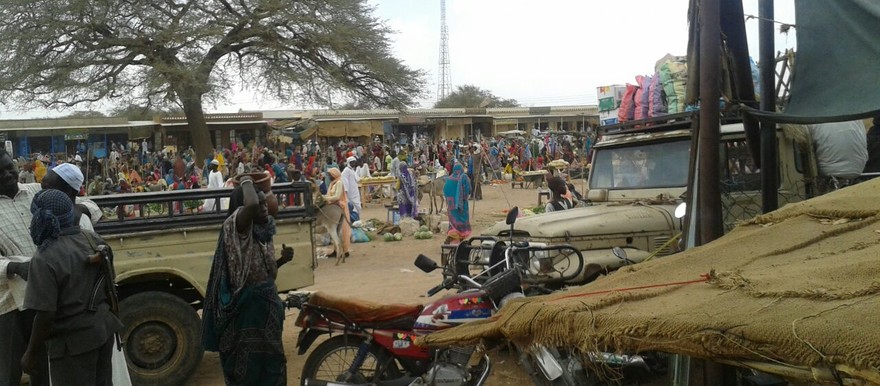
It was a serene evening at a crowded market in the village HigairTunu, South Darfur. This place was frequented by families- mothers, fathers, children and the elderly who greeted their neighbors and friends as they exchanged news of the community and purchased their weekly necessities. Suddenly, assailants besieged the market on camelback and opened fire on the unarmed shoppers. The torrent of bullets rained down on the innocent, transforming a peaceful scene to one that was chaotic and tragic.

One can only imagine the anguish of this heartbreaking scene. Mothers holding their crying children, men and women falling from gunfire, people confused and terrified at the commotion.  In the frenzy, the market’s tables overturned spilling the goods and produce like the blood spilled from the market frequenters. Life and lives were lost in the market that night. Among the survivors, the loss changed their lives forever but in terms of the violence, life was unchanged.

It was June 5 when the armed militiamen killed these Darfuri civilians in the market. The crime has not yet been solved. Both major rebel groups have condemned this violent attack on civilians. According to news reports, the governor of South Darfur has downplayed the incident, referring to the attack as a “quarrel” between four men and a female market seller.

A local community leader has pointed out that the government and security community failed to order any of their forces to trail the gunmen. The leader criticized the government, emphasizing that “criminals are still armed, even though the government has made much of its recent disarmament campaign”. Displaced civilians in Darfur have also been unimpressed with the government’s reforms to address the violence and complain that the violence has not ebbed. Particularly, the civilians have charged state-backed militias with attacking them and appropriating their land.

According to U.N. estimates more than 300,000 people were killed in Darfur conflicts over the past 15 years and upwards of 2.7 million became displaced. We must keep alive the memory of this violent act and so many others. A civilization depends on our ethical compass for bringing justice to those afflicted by persecution in Darfur. Our compass must guide our efforts in aiding and empowering the Darfuri women, men, children and elderly because an attack on their human rights is an attack on all of us.

It is incumbent upon the international community to be vigilant in monitoring violent incidents in Darfur and Sudan. Clearly, the right to peacefully assemble at a market is something the world can understand and support.

Attacks of its kind are not new to civilians in Darfur and nor are a single incident, it’s a part of a deliberate policy of the government of Sudan to eliminate the people of Darfur which are well documented over the last 14 years. The international community must meet its responsibility by challenging the regime in Sudan and make it clear that impunity for such horrendous crimes is not an option.  We must demand that of all of our leaders including the US government.


Maxfield- Outreach Intern

Justice for Noura

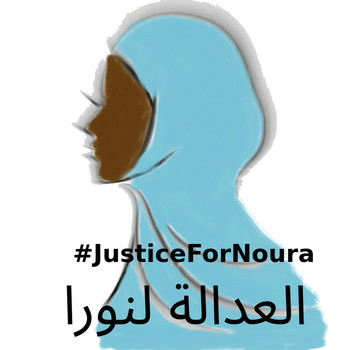
At the age of 19, Noura Hussein has been sentenced to die. A court in Sudan ruled that she was guilty of premeditated murder and thus was given the death penalty, execution by hanging. Of course, this is the end of a story that has been determined by widespread misogyny and mass human rights violations. When Noura was just 16, her father forced her to marry. Noura managed to escape to her Aunt’s house for three years.


But in 2017, she was tricked into coming home. Her father had told her that he had canceled the wedding and she was free to return home. Once she came back to her family’s house, Noura realized she had been tricked and was forced to marry. During the four days following this wedding, Noura refused to consummate the marriage until on the fifth day, she was forcibly held down by multiple male relatives, the majority related to her husband, while her husband raped her. The following day, her husband attempted to rape her again, and in a panic-driven act of self-defense, Noura stabbed and killed him. Noura went to her parents’ house for help, but her father turned her into the police for what she did. She was tried with premeditated murder and found guilty. Her husband’s family refused offers for compensation and instead demanded execution by hanging.


The verdict of Noura’s case reflects an unjust and misogynistic justice system and demonstrates just how deeply rooted human rights abuse is in Sudan. Also, Sudan has also twisted Sharia law to justify these practices. For example, Article 91 of Sudanese Family Law: “A married woman must obey her husband if he has paid the dowry and provides a suitable home.”  This Article has been used against Noura, saying that it was her duty to consummate the marriage as shown by the law, and through Islam. However, this marriage was not consensual nor was it actually a marriage, and the justification of this marriage is utterly inaccurate according to Islamic law, which prohibits forced marriage. The Sudanese Constitution also prohibits forced marriage, meaning that it was not a case of marital rape, but this marriage cannot be legally recognized.


Probably the worst part of Noura’s situation is how common it is. Forced marriage is common, in Sudan, as is marital rape, and Sudan’s inability to hold the preparators of these crimes accountable and to punish the victims is a clear mass affront to human rights norms. The Sudanese Government has been actively carrying out a genocidal campaign in Darfur for over fifteen years, and forces regularly use rape as a weapon of war. The regime of indicted-war-criminal President Omar al-Bashir has been riddled with the systematic abuse of civilians and has been justified using a twisted version of Islamic law.


We must take action and demand justice for Noura! And many other women whose stories  of abuse have gone unnoticed. If Noura is executed the continual oppression of women in Sudan will continue and we must ensure that this never happens to another woman. As allegations coming out that right now, the Trump Administration is working on normalizing relations with the Government of Sudan, which will only solidify Sudan’s current human rights abuses. We must raise our voices and ensure that the US does not reward Sudan for their continuing and worsening human rights violations. If the US continues to do warm relations with Sudan, there will never be justice for Noura, only the continual oppression of women in positions similar to her.