December 9th marks the International Day of Commemoration and Dignity of the Victims of Genocide, and December 10th marks International Human Rights Day; both of extreme significance to DWAG’s mission and to the people we strive to protect.
We wish to take this opportunity to reflect on our collective conscience and the moral standard that makes these two significant occasions a reflection on realities, not rhetoric. As the world commemorates these important milestones, sadly, the people of Sudan are mourning the victims of multiple genocides that the world has not only failed to protect but also failed to recognize and take action to restore their dignity.
These dates must not be a cause for celebration rather serve as a reminder to the legal and moral obligations that our international institutions and their leaders have vowed to uphold.
Protection of human rights and the recognition of the dignity of the victims of genocide begins with accountability and the dignity of all victims of the past and present. It’s worth noting that this is not only orally imperative, but it’s a legal obligation and a duty arising from the International Declaration of Human Rights. A duty to equally defend the dignity of every human life and the responsibility to protect and prevent mass atrocity wherever it occurs. Yet, as we observe these days, Sudan, particularly Darfur, Kordofan, and El Fasher, where slaughter has reigned supreme, stands as one of the most devastating failures of international protection.
Evolving from 20 years of genocide in Darfur, for more than two years, the war between the Sudanese Armed Forces (SAF) and the genocidal paramilitary Rapid Support Forces (RSF) has subjected Sudanese civilians to an unprecedented tragedy with starvation, ethnic killing, mass rape, aerial bombardment, destruction of services and infrastructure, and months-long siege. The Universal Declaration of Human Rights promised: “all human beings are born free and equal in dignity and rights.” However, Sudanese civilians today are left with neither dignity nor rights, only mass graves, scorched villages, disappearance, and hunger.
Escalating Human Rights abuses in Darfur
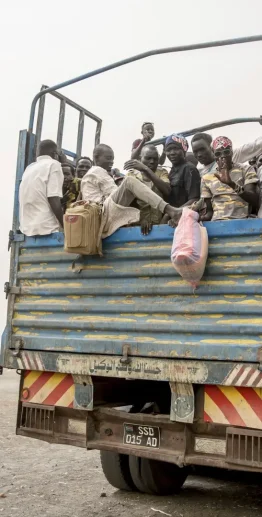
Over the past year, Sudan’s crisis has escalated into a full-scale genocide, once again marked by mass killing, starvation, sexual violence, forced displacement, abduction, and indiscriminate attacks on hospitals, markets, and displacement camps. Since 15 April 2023, more than 12 million people have been forcibly displaced, with roughly 7.3 million internally displaced inside Sudan and over 4.2
million refugees or asylum-seekers abroad¹. In El Fasher alone, thousands were killed as the city fell to the Rapid Support Forces (RSF) on 26th October, 2025, after 18 months of brutal siege in the region. Conflict-related sexual violence has reached emergency levels, with women and girls abducted, raped, and targeted at checkpoints, in their homes, and along escape routes. In North and West Kordofan, entire villages have been emptied as families flee RSF raids, road blockades, and executions. Across Darfur, communities are trapped without food, medicine, electricity, or safe passage, facing famine and ongoing siege warfare. Accoding to the WPF, across Sudan, over 26 million people are facing acute hunger. Famine has been declared in both North Darfur and South Kordofan for more than a year, with malnutrition among children reaching the breaking point, where a child dies every two hours, in Darfur camps according to MSF’s 2024 mortality and nutrition survey in Zamzam camp.
A lack and disregard for protection of civillian life
Despite repeated international warnings, there has been no meaningful protection for civilians. Health workers have been killed while treating the wounded, humanitarian supplies have been looted, and medical facilities have been bombed and occupied with impunity. In October 2025, the last functioning hospital in El Fasher, Saudi Hospital, was transformed into a killing field when the paramilitary Rapid Support Forces (RSF) stormed it, killing nurses, doctors, and over 460 patients and their companions. Aid agencies remain blocked from reaching those starving in Darfur and Kordofan, while women and children continue to flee without shelter, food, or medical support. The absence of protection mechanisms has made Sudan one of the most dangerous humanitarian environments in the world. According to the UNRIC, more than 30.4 million people now require urgent humanitarian aid, with large swathes of the population facing food insecurity, no access to clean water or health services, and zero protection from violence2.
Systematic dismantling of internally displaced camps, a sanctuary place where displaced persons are supposed to be protected under international law. The attack in Zamzam camp should have shocked the world conscience or prompted them to act; regrettable, it was only a few words of condemnation that rather emboldened the perpetrators to continue to kill more people. RSF has deliberately dismantled the camps with the intent to uproot the indigenous African Darfuris from their homes and to remove the evidence of their crimes
Impunity for serious international crimes
For more than two years, perpetrators continued to perpetrate serious international crimes without consequence. RSF has used mass slaughter, mass rape, ethnic targeting, starvation as a weapon of war, and the burning of entire communities have been documented, and yet accountability remains out of reach for survivors and the affected communities. Despite some steps the international community has taken but protection and justice, especially in Darfur, remain far beyond reach. Recognizing the work of the UN Fact-Finding Mission on Sudan (UN FFM) and the extension of its mandate, which was made by survivors, advocates, and civil society, who refused to let the world look away. The conviction of Ali Kushayb marks the first conviction for crimes connected to the Darfur genocide by the Internationa
Criminal Court. These are steps in the right direction; however, the perpetrators have yet to be apprehended or held accountable. Without an independent civilian protection mechanism, effective and unhindered lifesaving aid delivered to all in need, and both perpetrators and enablers of the past and present crimes held accountable, Sudan will never be at peace.
It’s worth noting that accountability can’t be achieved without all international and regional actors meeting their obligations to all international and regional mechanisms, including the Genocide conventions, International Human Rights and humanitarian law, other universal and national mechanisms reinforcing accountability that narrow the space for perpetrators. Multilateral and bilateral pressure must be applied to ensure that impunity for such crimes is not an option. We are extremely disturbed to see a man who has funded, financed, and supplied weapons for RSF to commit genocide has been flying across Europe and the United States while remaining under sanctions by both the European Union and the United States. Recently, as survivors still plead for protection and justice, global responses remain inconsistent and deeply politicized. At a time of slaughter in Darfur, as women and children are being hunted across Darfur, RSF Commander and finance’ Algoney Hamdan Dagalo, the man leading forces responsible for massacres, mass rape, and starvation, was received in Washington, D.C., as a political actor rather than a wanted violator of international law. In December 2024, the same man ( Algoney Dagalo) traveled across Europe while being under sanction. This contradiction is dangerous. It sets a precedent everywhere that power can outweigh justice, and that violence can secure negotiation rather than accountability.
On days dedicated to universal rights and dignity for all humans, we urge the UNSC and the international community to take stock of measuring progress toward these two important milestones. Renew commitment to the moral and legal obligation. Ensure that recognition of dignity can’t be selective, and Sudan must not be an exception. The genocide unfolding in Darfur and the broader war across Sudan are not inevitable; they are the result of delayed action, geopolitical neglect, and the normalization of atrocity. The declarations and patches taken these days must not be reduced to symbolism, but must serve as a reminder that the world promised “never again,” and that promise must be honored for Sudan.
As we observe International Human Rights Day and the International Day of Commemoration and the Dignity of Victims of Genocide, DWAG urgently calls on the United Nations, the African Union, and all international partners to:
The people of Darfur and Sudan deserve the full protection of international law immediately. Silence has never stopped genocide; only collective action, accountability, and protection can.
As DWAG continues its mission to center survivors, amplify women’s leadership, and build a future free from genocide, we ask the global community to stand with us by supporting our One Million Voices for Sudan. Your voice can influence and compel leaders, media, and institutions to break their silence and enforce their international obligations.
If you are able, please support DWAG’s End-of-Year Humanitarian & Justice Fundraiser. Your contribution enables survivor-centered documentation, emergency advocacy, and global accountability efforts.
Together, we defend human dignity, demand protection, and affirm that the lives of Sudanese women and children are not expendable.
Niemat Ahmadi
Founder & President
Darfur Women Action Group

March 15 - 2025
March 13 - 2025
+ Read More