
Opening Remarks
The event opened with remarks from Niemat Ahmadi, Founder and President of DWAG, followed by remarks from Ambassador Sandra Jensen-Landi, Deputy Permanent Representative of the Denmark Mission to the United Nations and Ambassador Kate Foster, OBE, Deputy Permanent Representative of the United Kingdom Mission to the United Nations.
Ahmadi opened the event by discussing how the conflict in Sudan is entering into its fourth year; however, for conflict-affected groups in Sudan, “it is several decades of atrocities.” She stated the importance of atrocity prevention as a tool to resolve the conflict in Sudan.
“In Sudan, systemic atrocities have mostly been treated as traditional conflict resolution. There has never been an atrocity prevention approach to Sudan…When the situation becomes this magnitude…it cannot be resolved with traditional conflict resolution mechanisms.” – Niemat Ahmadi
Ambassador Jensen-Landi discussed the horrific violence, displacement, and hunger faced by the people of Sudan, with women and girls bearing the brunt of the conflict.
“The question before us today is not whether we know what is happening. We do. We know the warning signs, we know the patterns of violence, and we know who’s most at risk. The question is whether we act on that knowledge.” – Ambassador Sandra Jensen-Landi
Additionally, Ambassador Jensen-Landi listed three important points involved in acting on the knowledge we have about what is happening in Sudan: early warning must mean early action; the protection of civilians must be real, local, and immediate; and there can be no sustainable peace without civilians at the table.
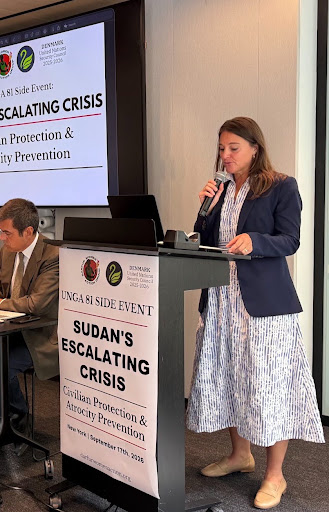
Ambassador Foster, OBE, addressed the urgent need to strengthen civilian protection and prevent atrocities in Sudan. She stated the importance of focusing not on the numbers, but on the people that sit behind the numbers of every one of the 33 million people requiring humanitarian assistance.
Furthermore, Ambassador Foster discussed how the burden of this conflict falls overwhelmingly on women and girls and that “rape, gang rape, sexual slavery, forced marriage, forced pregnancy, and abductions for sexual exploitation have become defining features of this conflict.” However, she commended the bravery of Sudanese women who continue to be at the forefront of the response in Sudan despite these horrific acts of conflict-related sexual violence.
“Sudan is not only a story of conflict, it is also a story of extraordinary courage and resilience.” – Ambassador Kate Foster, OBE
Understanding Sudan’s Escalating Crisis
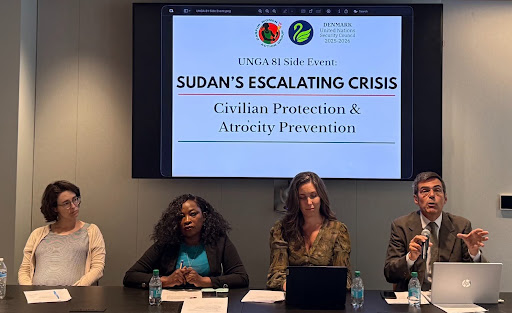
The first session featured Niemat Ahmadi, Laura Mills (Amnesty International), and Dr. David Donat Cattin (NYU School of Law), moderated by Tess Graham (Global Justice Center).
The panel examined the current situation in Sudan from the perspectives of survivor-led advocacy, human rights documentation, and international law.
Ahmadi summarized the crisis in Sudan and the role of the international community in bringing us to this point. She stated that it is hard to see hope in Sudan, as the number of people killed and the number of people who have been displaced from their homes have yet to be documented.
Ahmadi described the systemic killing of people and depicted the continued genocide in Sudan, describing how “entire families were wiped out, exterminated. There is no one left to tell the stories of these families.” Ahmadi also described “the systemic approach to make survival impossible,” with the RSF looting properties, markets, pharmacies, and hospitals, destroying food, burning buildings and villages, and killing doctors.
Additionally, Ahmadi asked for media attention and discussion about Sudan, especially ahead of the United Nations’ 81st General Assembly. She stated the importance of holding perpetrators accountable for their war crimes and genocidal actions in Sudan.
“And for once, we want the international community to make this investment count by taking an atrocity prevention approach that prioritizes documenting these atrocities and providing civilian protection.” – Niemat Ahmadi
Mills shared some of the key findings of Amnesty International’s July report: “City Under Siege, Children Under Fire.” She stated that of the eleven crimes against humanity in the Rome Statute, the RSF has committed eight of them, including mass rape, sexual slavery, mass hostage-taking, widespread killing of civilians, and persecution on the basis of ethnicity and on the basis of gender.
Mills described the RSF’s widespread use of sexual violence at every stage of the conflict, hostage taking at mass rates, children being used as ammunition and forced to fight, and the unlawful means of capturing El Fasher, with the entire city being slaughtered. Mills also described the abuses committed by the Sudanese Armed Forces (SAF), discussing the severe violations committed by them.
“No where in Sudan is safe.” – Laura Mills
Dr. Donat Cattin described the international roots of the conflict in Sudan and the role of external actors and impunity in bringing us to this point. He discussed the trade and trafficking of gold and diamonds from conflict zones, including Sudan, and the need for real measures of accountability regarding the normalization of war and the trade of goods produced through human rights abuses.
“We need to use what we have, international law. We don’t have a world government and a world army to stop those warmongers and authors of atrocity.” – Dr. David Donat Cattin
In the panel, Niemat Ahmadi, Laura Mills, and Dr. David Donat Cattin examined the current situation in Sudan from the perspectives of survivor-led advocacy, human rights documentation, and international law. The panel highlighted the need for civilian protection and atrocity prevention, addressing the necessity for the international community to take action on the crisis in Sudan.
Key Recommendations
The panelists discussed a list of concrete steps that should be taken to strengthen civilian protection and atrocity prevention in Sudan.
Among the key recommendations raised were:
The United Nations Security Council and the greater international community have many tools at their disposal, including political pressure, monitoring and documentation, sanctions, and accountability mechanisms, and we must use these tools to prevent and end genocide.
Protection of civilians cannot remain abstract; it must mean access to food and medicine, protection from sexual violence, and supporting those already protecting their communities.
Although an arms embargo is not a complete solution, arms need to be made more expensive and difficult to access; it is far too easy for war crimes and atrocities to be committed in Sudan.
Countries should operationalize universal jurisdiction and make it more difficult for those committing genocide and atrocities in Sudan to travel and to freely live their lives with impunity.
The international community must not forget Sudan; the genocide in Sudan must gain attention in the public eye and the international community must listen to the voices of victims and place them at the forefront of policymaking and advocacy work.
Q&A Session and Closing Remarks
The event concluded with a powerful Q&A session, opening the floor to questions and remarks from the audience. This session was followed by closing remarks from moderator Tess Graham.
“What we’ve heard here today is that the bare minimum decent requirement would be to make it prohibitively expensive and inconvenient to be a war criminal, to be a genocider, to commit crimes against humanity.” – Tess Graham
Looking Forward
Sudan’s escalating crisis requires sustained attention beyond moments of international visibility. Civilian protection and atrocity prevention must remain central to international discussions regarding Sudan, alongside accountability for serious international crimes and continued support for Sudanese civil society, notably women.
For DWAG, this means continuing to center the voices and leadership of Sudanese women, survivors, and communities directly affected by the conflict while working with international partners to push for stronger protection and accountability for victims.
To learn more about DWAG’s work and current actions on Sudan, contact outreach(at)darfurwomenaction.org