
27 October 2026
New York City- At a high-level event organized by the UN Fact-Finding Mission for the Sudan and the Office of the Special Adviser on the Prevention of Genocide, DWAG Founder and President Niemat Ahmadi was invited to participate as a speaker.
The event, “From Warning to Prevention: Protecting Civilians in Sudan and Preventing Further Mass Atrocities” analyzed the situation in El Fasher one year after the RSF besiegement and takeover of the area and urgently warned for sustained monitoring and engagement in El FObeid and Ed Damazin. DWAG Founder and President Niemat Ahmadi gave her testimony alongside distinguished speakers, including Mr. Mohamed Chande Othman, Chairman of the UN Independent International Fact-Finding Mission for the Sudan and Dr. Chaloka Beyani, UN Special Advisor on the Prevention of Genocide.
The current situation in El Fasher, one year after the worst atrocities in the history of the city, is extremely critical. Before the RSF’s genocide and takeover, 2 milllion civilians lived in El Fasher and surrounding rural areas. Now fewer than 70,000 residents remain in el-Fasher, living in a constant RSF surveillance state. Tens of thousands of people who were captured, abducted or disappeared during and after the October 2025 takeover remain unaccounted for, with many being held for high ransoms.
The women and children of El Fasher, who endured atrocious acts of sexual violence, have yet to meet justice. They continue to face deliberate targeting, dehumanization, sexual violence, and a lack of basic necessities.
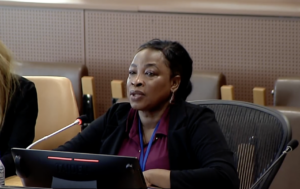
DWAG Founder and President Niemat Ahmadi speaking at the event, “From Warning to Prevention: Protecting Civilians in Sudan and Preventing Further Mass Atrocities.”
Reports indicate some remaining civilians have been forced into unpaid labor, such as cooking for fighters or collecting bodies. Over half a million displaced people are crowded into areas including Tawila and Dar Es Salam. These cities, originally built for 20,000 to 40,000 people, now face critical shortages of food, clean water, shelter, and medical care. Over 3,400 newly displaced individuals arrived in Tawila alone in September 2026.
Speakers emphasized the ethnic targeting of the Zaghawa, Masalit, and Fur communities through documented patterns of humanitarian relief blockades, the destruction of markets, farms and civilian infrastructure, and the siege tactics affecting the civilian population. The targeting of water sources, markets, hospitals, looting of vehicles, and siege warfare prevented access to food and medical supplies, quietly killing Sudanese people with no trace. Starvation is deliberately employed as a weapon of war precisely because it produces no noise, flame, or smoke.
DWAG Founder and President emphasized:
“The international community has failed the people of Sudan and the people of Darfur particularly because El Fasher was preventable and it was not prevented. Why? Because this murder and this genocide and the systemic killing did not happen in vain or between two militias or generals. It is well supported by external actors who are acting on behalf of these militias.”
External support was scrutinized as the role of state and nonstate actors fuel the conflict.
On September 3rd, the Fact-Finding Mission for the Sudan released a report, “Fueling Sudan’s Conflict: Weapons, Fighters and External Support Networks,” documenting the recruitment, training, and deployment of foreign personnel by transnational entities to support the RSF. This builds upon the September findings detailing how the war economy sustains Sudan’s conflict through the exploitation of Sudan’s gum arabic value chain and other exported resources including gold. Investigators noted the transfer and supply of weapons, ammunition, military technology, personnel and logistical network linked to countries including Colombia, UAE, Chad, Libya and Somalia, who are aiding and abetting genocide against the people of Sudan. This not only constitutes war crimes but points to an international network of criminality.
DWAG calls on the international community to implement and enforce EU gold and mining-chemical sanctions in addition to diplomatic pressure and sanctions from the US, UK and Canada. Read our briefing on the Human Cost of Sudan’s War Economy.
More recently, the Independent International Fact-Finding Mission for the Sudan released a new report entitled “Sudan’s Unrelenting War: Civilian Devastation and Deepening Insecurity in El Obeid” on October 28, 2026, documenting the escalating dangers civilians face in El Obeid. This includes intensifying state repression, drone warfare, and attacks on vital infrastructure, developments we saw unfold in El Fasher before the biggest massacre in El Fasher’s history. Across the country, including regions in the Blue Nile State and the Sudan-Egypt border, civilians continue to endure increasing drone strikes and other assaults, which have already killed dozens of civilians. Because the SAF has also increased violations of civilian rights, including mass surveillance and arbitrary arrests, intervention to stop both warring parties is urgent.
Expert speakers agreed that warring factions and state-sponsors will not stop on their own. Naming and shaming, action from the Security Council, criminal sanctions, and unified international demands are essential to hindering weapon supply, expertise and personnel support from state sponsors, with emphasis on the UAE. Experts also warned of regional destabilization in Chad, Niger, Mali, Mauritius and the Central African Republic, while emphasizing the need for early action following early warnings.
How many people have to die before the international community acts?
The evidence is well recorded by the Fact-Finding Mission and most extensively by the perpetrators who fear nothing because they face no consequence or accountability for their past and present crimes. RSF fighters recorded their testimonies and broadcasted the massacres in el-Fasher. The world saw the videos but refused to act. Al-Geneina is still in turmoil from the lack of justice or intervention before, during, and after the massacre of 2023. Now El Obeid faces similar siege conditions and requires urgent action, as well as the areas in Blue Nile State.
Despite over 25 years of UN policy framework to protect Women, Peace, and Security, Sudanese women endure violence and death daily. Women are excluded from the decision making process, despite being mandated by the WPS Agenda. Women and children desperately need access to lifesaving aid and dignifying treatment after experiencing rape and sexual violence at the hands of the RSF. As we commemorate the UN’s Women, Peace and Security week, it is difficult to reckon with the failures of the international community. At Darfur Women Action Group, we call on the international community to act now:
- Fully resource and support the UN Fact-Finding Mission to document atrocities, secure evidence, and prosecute crimes of genocide, sexual violence, ethnic targeting, and mass starvation as weapons of war.
- Open safe humanitarian corridors with guaranteed and unobstructed access for food, medical aid, fuel, and emergency lifesaving aid agencies, including cross-border corridors through Chad and other routes, as well as holding the RSF and those who obstruct, attack, or blockade aid access accountable.
- Deploy international protection forces under Chapter VII mandates to safeguard civilians, displacement camps, hospitals, and humanitarian aid workers across Sudan, especially for the sake of women and children who are most vulnerable to humanitarian abuses and sexual violence.
- Enforce an immediate and sustained ceasefire with civilian protection guarantees, including an immediate halt to all RSF aerial bombardment, drone strikes, and siege tactics, and mandate the withdrawal of RSF forces from civilian zones in El Fasher, El-Obeid, El Geneina, and throughout Darfur and Kordofan.
- Expand the arms embargo to all of Sudan by cutting the weapons pipeline feeding genocide, including enforcement against all international, regional suppliers and intermediaries known to be arming the RSF.
- Demand RSF withdraw from El Fasher to create an enabling environment for lifesaving aid and enable survivors to restore their dignity.
- Listen to and integrate the voices of survivors, women, and affected communities in all decision-making related to resolving this crisis and preventing future atrocities.
See the event recording here.
This blog was written by Magdalena Goles DWAG Campaign Intern